

Many people feel understandable psychological and cultural discomfort with our political and geopolitical break with Europe. It would be more accurate to say, with the West, because Oswald Spengler in his "The Decline of the Western World" no less justifiably wrote that Europe is "an empty sound" and that in cultural and civilisational terms we can speak only of the West and Russia.
Tyutchev and Berdyaev thought the same way, and Dostoevsky, in his Pushkin speech, spoke of Russia's mission to "resolve European contradictions definitively". In this he saw a way out of the "European longing" in our souls. But is it realistic now, 140 years later, and do we "yearn" for Europe so much after two world wars and everything that has fallen to our share due to the fault of the "Faustian soul" (Spengler) of people and especially the elites of Western civilisation?
Should we regret this rupture, which was provoked by the West in its selfish geopolitical interests through a very immature attempt to challenge us in Ukraine. A challenge at the level of identity and history, including an attempt to retroactively rehabilitate Nazism? I will try to answer this undoubtedly topical question.
To begin with: which Europe and which West are we talking about?
From a purely external point of view: those who can compare Europe with what it was 30-40 years ago will say that that Europe simply no longer exists. It has remained in our consciousness (including films) and somewhere in the hinterland. This hinterland, namely the majority rooted in their countries and regions, opposes cosmopolitan elites, who have been successfully and in every way during all these decades simply draining their countries into the gutter (it is difficult to find another definition - I observed it in London).
Most elites and media deny this and try to discredit patriots by labelling them as "populists". Then why are the French resignationists warning of a coming civil war on the grounds of defence of a historically established national identity? Why does Lech Walesa warn about the same in relation to his own country? Why do Americans themselves admit that they have "culture wars", i.e., again, over the traditional American identity being "merged" by the ultra-liberal elites?
Yes, for three centuries we have thought of ourselves as Europeans, even though Europeans have never thought of us as such and have never accepted us until today. Could it be that they are ultimately right? And why can't we have our own identity, different from the Western identity, if the whole history speaks about it, including the liberation of Europe from Napoleon and Hitler? After all, they lived, and not too badly, under both! They felt some discomfort, but for us such an existence was absolutely unacceptable.
Let's dive into culture
Spengler makes a distinction between culture and civilisation. For him, Western culture ends in the XVIII century, completing with Baroque music a succession of changes of great styles - first came architecture and then painting. He writes about literature only in the second volume and in relation to Tolstoy and Dostoevsky in Russia: he considers the Christianity of the former to be a "misunderstanding" and the latter to be "the Christianity of the next millennium". The whole long - from 1789 to 1914 - nineteenth century is thus transitional in relation to the tragedies of the twentieth, including the Russian Revolution, through which we shared these catastrophes with Europe.
We can speak of Romanticism as a short, but with important consequences, transition (fancy term!) in the spirit of the longer Mannerism in painting - with such iconic figures as Napoleon, Byron and Beethoven. German classical philosophy also (is it so by misunderstanding?) came in here. And perhaps the fact that Spengler died early, refusing to co-operate with the Nazi regime, and Martin Heidegger, like virtually all of the professoriate, joined the Nazi Party in 1933 and was denazified in France, means something.
Postmodernism emerged in left-wing political thought precisely as a reaction to the tragedy of Nazism, to the biopolitics of Western elites who perceived the population as biomass, to the fact that the commandant of a concentration camp could read Goethe at his leisure. He (with Jean Baudrillard) is responsible for the development of the idea of posthumous existence, which has been the entire existence of the West since the French Revolution, which the Bolsheviks, with the help of the Duma's Anglophile liberals, imitated in our country.
Proust is deeply symbolic in this respect, even to the point of being literal. In a strange way, the 19th century began with dandyism and ended with it, including in our country. Maybe as an attempt to artificially prolong the Gallant Age (Leonid Grossman raises this topic)?
On the relationship between cultures and our European identity
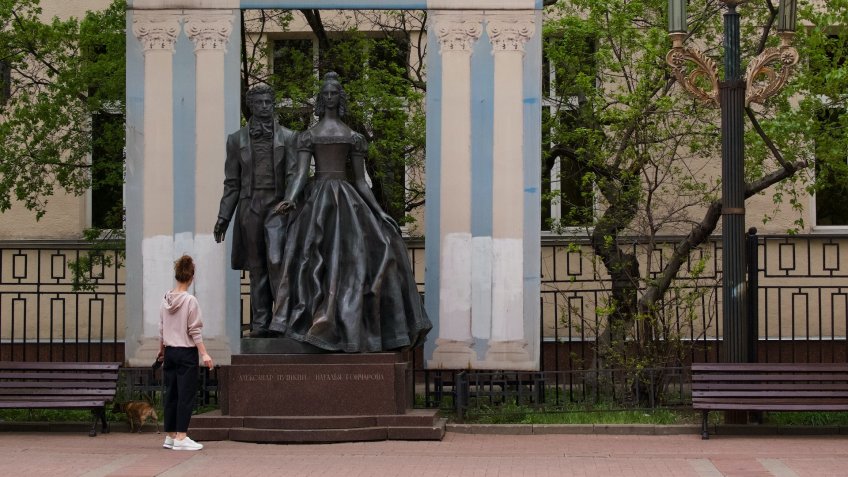
Let's start from afar. The brief Elizabethan Renaissance literally capped the achievements of three centuries of continental development by producing Shakespeare. Then there was Richardson with his Clarissa, a volume twice the size of War and Peace. Shakespeare was remembered two centuries later (leaving aside Jonathan Swift and some others), when the baton of English literature was picked up by women - Jane Austen, the Brontë sisters, Mary Shelley, Etcetera. Our most European author was Pushkin, through whom we absorbed the best of Europe, and Little Tragedies became a mini-Shakespeare.
Moreover, we were more committed to the ideas of the Enlightenment, which, as the British philosopher John Gray writes, greatly disappointed Joseph de Mestre when he arrived in St Petersburg as the Sardinian envoy. At least at the Congress of Vienna, Alexander I had placed defeated France, which had survived the Restoration and renounced "Napoleon's personal conquests", at the common table of the European powers. Such a thing had not happened in European and world politics since then, and Napoleon III's France also started the Crimean War.
Let's take Ukraine and Russia. Nikolai Trubetskoy wrote in exile on the Ukrainian question that the Ukrainianisation of the all-Russian language took place under Alexei Mikhailovich, when church books were corrected according to the Kiev models. After that, any Ukrainianisation would mean provincialisation with all its disgusting consequences, which we have seen in the last 30 years. Trubetskoy's rightness is evidenced by the genius of Gogol, particularly his Taras Bulba, so talentedly adapted by Vladimir Bortko.
Virginia Woolf, in her essay "The Russian Point of View," writes of the radical difference between the literature of Tolstoy, Dostoevsky, and Chekhov and that of England, with its "incomparable sense of freedom." The former Archbishop of Canterbury Rowan Williams, in his study of Dostoevsky's work, superimposes theological analysis over Mikhail Bakhtin's conclusions when he concludes (this is 2008) that Dostoevsky's iconography asks his readers "whether they are able to conceive that humanity only becomes itself when it becomes a reflection of the other", and that this question is among other things "political and unmistakably contemporary".
John Gray, in this year's New Leviathans, recognises the universal significance of the prophecies of Dostoevsky, in whom, according to Innokenty Annensky, "both the Karamazovs and the demons lived", although he dispenses with his seminal The Legend of the Grand Inquisitor and the ideological lusts of Pyotr Verkhovensky, scaring Western countries that they, especially the Anglo-Saxons, are repeating us with their ultra-liberal revolution, creating a new, "naked" man, cleansed of national identity.
Doesn't it then turn out that Europe is us, since we picked up the baton of its culture in the 19th century (compare with Trotsky, who - in a recent TV series - told his assassin that he never understood anything, namely that he was the revolution)? This is not Ukraine's "Tse Europe!", which our neighbour has fallen for in its deaf provincialism, enthusiastically allowing itself to be taken advantage of.
We are the continuers of that great cause, which is commonly called European culture, for which we stood as a shield. It lives in us. While it is self-destructing and self-denying in the West within the framework of "cancellation culture" and Russophobia. It still lives there in films like Onegin, where Rafe Fiennes gives an image of the protagonist that is easy for us to accept (yes, it's Pushkin!). In "The Reader", the protagonist is a former concentration camp guard, condemned by judges who judged under the Nazis, who condemns herself when she learned to read and humanised herself thanks to Chekhov's "Lady with a Dog". There is inhumanisation going on there now - not of us, but of ourselves!
What is there to regret?! There's nothing there anymore! We will keep everything valuable, and even in international relations - without us there will be no multipolar space of freedom for all other countries and peoples. As for America, as Gray writes, in its ultra-liberalism it looks "parochial" and even in other Western countries the "wokeism", which pretends to be a global movement, is viewed with "indifference, shock, embarrassment and contempt". And yet the ultra-liberal vision persists that "all societies are doomed to undergo the same deconstruction that is taking place in the West."
Blok's "Born in the years of the deaf" is already about them. We have gone through what Vasily Rozanov described in his death-defying "Apocalypse of Our Time" (and which Gray quotes):
"With a clang, a creak, a squeal, an iron curtain is lowered over Russian History (Churchill borrowed it for a reason?).
- The performance was over. The audience has risen.
- It's time to put on our fur coats and go home.
We looked round.
But there were neither fur coats nor houses."
Are we to go through this again, now with Europe? It depends on them, not on us, whether the same thing will happen to them - "as God blew out the candle". We still have our "fur coats" - firewood, hydrocarbons, farmland, forests, fresh water and other natural resources. And we do not sit in the auditorium, but act on the stage. It is a good time to think about ourselves and the rest of humanity - quite in the spirit of "enlightened egoism", which we have always lacked.
Alexander Kramarenko
Director of the Institute of Current International Problems of the Russian Foreign Ministry's Dipacademy
Ambassador Extraordinary and Plenipotentiary.