

Andrei Bezrukov, a retired colonel of the Foreign Intelligence Service, advisor to the president of Rosneft, and expert of the Valdai Discussion Club, gave an act lecture in St. Petersburg on "The Future of Russia and the World. The New Political Landscape." He shared his vision of the causes of the current global crisis, as well as its consequences. Forpost presents excerpts from the speech.
There is nothing new under the sun
Andrei Bezrukov: If someone over a hundred years old were in the audience, there would be nothing new for him in the current situation. The last time the world went from one state to another was exactly 100 years ago. It was a bloody transformation. And all the factors that led to it then are now in place, too.
At the beginning of the twentieth century, the world made a huge technological leap. Airplanes, radio, internal combustion engines, which gave birth to the oil economy. The technological base began to change rapidly. Just an example - in 1914, the main means of transport in St. Petersburg were horses, but by 1945 they were completely replaced by automobiles.
Those countries where the process of technological change was faster began to take the lead. These were Germany and the United States, which were gradually conquering new markets and spaces. At the same time, Britain and France ruled the world globally, dividing the planet between them by creating colonies. At one point, London and Paris realized, just as the U.S. does now with respect to China, that if nothing is done, the Germans will soon become stronger than they are. So they decided to have a "little war" called World War I.
Now the same thing is happening. The U.S. directs all possible resources to slow the development of China and Russia, because they understand very well: by 2025 we must complete the program to rearm the army, and by the 30th year it will be done by China. It will be very problematic to catch up with us afterwards.

The geopolitical situation is very similar to that of 100 years ago. Washington, like France and Britain before it, has built a legalized system of world control through dollarization, control of financial institutions and other international organizations, it "holds in its fist" the entire world economy. At the same time, for the last 20 years its growth is ensured not by the West, but by the East. Rising China, developing India, ASEAN. Europe, on the other hand, is losing its position and is losing the pace of development.
Wind of Change
Andrei Bezrukov: The Chinese say, "God forbid you should live in an era of change." We are living in it. The last time it lasted from 1914 to 1945, when the imperial system was completely changed to a completely different concept. It was created by the five victorious powers of World War II, but now the former model is no longer satisfactory to many. Brazil, India, other states have no voice in solving global problems, the established rules and foundations hinder their development. Therefore, there is an increasing demand from them to change the order established in the middle of the last century.
The main reason why it became possible is that for the first time in 500 years, since Columbus, the West lost its military-technological advantage, which allowed it to impose its ideology on everyone else throughout this historical period. Think of the colonization of India and Africa. If the local population had any questions, the metropolis would force them with cannons to abide by the established rules. That time is over. Not only because we have hypersonic missiles and they do not, but because the British army today is weaker than North Korea's.
Remember the 1982 conflict, when Argentina decided to take the Falkland Islands, which were very close to its territory, but Britain sent its navy there and took them back very quickly. Nothing like that will happen again.

The rich get richer, the poor get poorer
Andrei Bezrukov: In the '80s and '90s, the wind of freedom that destroyed the Soviet Union blew, largely because the West very skillfully controlled the sails. But now, like a hundred years ago, the wind of justice has blown again, which always rises when inequality between the rich and the poor grows. It has now returned to roughly the same parameters as at the beginning of the twentieth century.
The rich always get richer, and the poor always get poorer. Because the return on capital, and the rich live primarily through investment, is always greater than the return on labor. After the October Revolution, the oligarchy was very much afraid of a similar process in the West, and realized that it had to share. After World War II, it was already asked to share by the governments. The states needed somewhere to take resources to rebuild their economies, and so they went into the pockets of the capitalists, imposing huge taxes on them at 90%, and redistributed this money in the economy, that is, directed to those who work.
Consequently, a middle class emerged in the West, with houses, cars and something to lose. It stabilized society by taking a position between the rich and the poor. The economy of France, Germany, some other states grew by 5-7% a year. The demand for social justice was generally met, because the poor understood: through their labor they could obtain certain benefits that their fathers and grandfathers did not have.
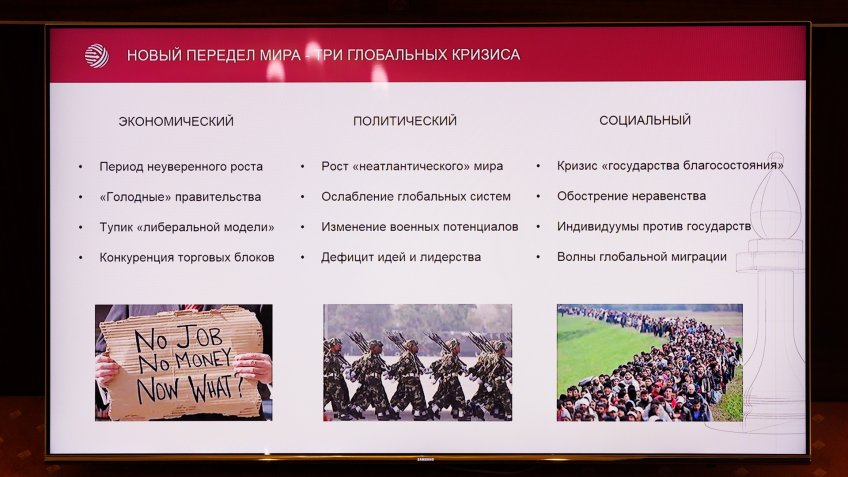
All this ended with the Reagan years, when capital reverted to its basic principles and for 40 years has been leading the world in the same direction it had been leading since the second half of the nineteenth century. The distribution of wealth has once again become less equitable. People in the U.S. and Europe have gotten used to living very well over the past 50 years, but their Governments, instead of providing this habitual way of life, are now cutting many social programs for which there simply is not enough money.
That model of the economy, which for many decades provided a constant upswing, was built on the growth of the productive forces. Today, only two out of $10 goes into the real economy, and the rest goes into bubbles. All this leads to an intensification of the struggle for markets and competition between the various blocs.
What is the way out? Either the states will again have to reach into the pockets of the rich and redistribute capital in order to ease social tensions, or we will get something like the Hunger Games. And it will end in something like "The Joker," when a mob with no leader, no subpoena, takes to the streets and smashes everything.
All the prerequisites for this exist. Now the middle class in the West is starting to disappear, because the industrial jobs associated with high-tech products are going to other countries. Children are realizing that they will never live as well as their parents. In the U.S. it used to be possible to get a degree from a university and immediately buy a house with a mortgage. But now young people are increasingly renting apartments because they don't have enough salary to afford their own home. Even on credit. Similar processes are going on in Europe.
The new political landscape. Causes and Consequences
Andrei Bezrukov: Society is divided into two camps, whose representatives have diametrically opposed views of the world, of history. Some, so to speak, consider the Soviet army, which entered Poland, as a liberator, others as a conqueror. How people have been taught, what worldview has been put in their heads, that is how they think.
The NATO concept spells out that the war is fought over knots, both logistical and semantic. And they are working in these directions. The West has been very good at two things. First, they were able to pull off an excellent operation, putting at odds two fraternal peoples who have lived together beautifully for the past 300 years. Secondly, they succeeded in tearing us away from our traditional markets.
But Washington has undoubtedly lost something. By going for broke, it has accelerated the process of reformatting the world, which previously was going quite slowly. The consolidation of the rest of the non-Western world has begun. Look: the outcome of the special operation is still unclear, but the queue to join the BRICS is nevertheless getting bigger and bigger. Algeria, Saudi Arabia, Argentina, Iran, Indonesia. All of these countries are not leaders. They would never risk it if they didn't understand whose side the momentum was on. They would have sat back, waited for the conflict to end, and only then would have decided whether to stay with the old hegemon or start building a new world. But they have already made their choice, because they understand who will be in charge in the next technological cycle.
The restructuring period will be turbulent, as it always has been. In the inevitable future, we will face a structural economic crisis associated with the transition from one technological cycle to another. Something like the Great Depression of the 1930s. This will lead to the breakup of the world into competing regions. Obviously, when you reduce the size of the market, the standard of living of the population will fall. Unfortunately, this process will occur everywhere, on a global scale.
Competition for the right to write new rules of the game will increase. Each country will be thinking about how to build up its defense, with whom to build alliances, not to be left alone with the enemy and to gain or retain access to raw materials.
The race to build a new technological base will make it necessary to mobilize all available resources. This will lead to an increased role for strong personalities. Putin, Xi, Modi, Erdogan, Trump. Only charismatic politicians will be able to convince society of the need to mobilize resources, and to force the part of society that remains dissenting to do so. There are no such figures in the European Union right now. So they are adrift, not knowing what to do next. They do not know how to avoid a complete collapse and degradation.
The countries are divided into two groups: those who through the redistribution of capital will avoid serious social upheavals and those who will not be able to avoid them. I really hope that Russia won't join the latter category and that we won't have to, like 100 years ago, lick our wounds for a while and then catch up with the powers that got away with it by putting in an enormous effort. But the Middle East is in the risk zone - the contrasts between the rich and the poor, the level of education that is real and the level of education that is necessary to meet the challenges of today, are too great there.