

Indonesian student Irwan Zwageri successfully defended his specialist diploma project on a topic he chose after completing an internship in Rostov-on-Don at the company "VIS-MOS." The company specializes in building infrastructure for the development of oil, gas, and other natural resource deposits, utilizing a new method of trenchless pipeline installation and microtunneling. Irwan Zwageri shared his impressions of the internship with Forpost, discussing whether the language barrier or cultural differences posed any challenges for him.

- I come from the island of Java, and in Indonesia, we don't have the conditions to study mining, which has always fascinated me. In my homeland, the metro system is not deep but above ground, there are very few mining quarries, and earthquakes and volcanic eruptions are common. Plus, I have always dreamed of traveling since childhood. Most of my peers went to study in the West, but that seemed uninteresting to me—too mainstream. Russia is rich in natural resources and has extensive experience in the mining industry, so I decided to study here. Empress Catherine II St. Petersburg Mining University has a reputation as one of the best educational institutions in this field. So, I enrolled in the "Mining Transport Systems" program (specialist degree), - says Irwan.
In addition to his primary profession as a Mining Engineer, in his fourth year, he also obtained a vocational qualification—third-grade crusher operator. He earned this certification after an internship at EuroChem in the Murmansk region. In fact, he stayed at the company even longer than required—he was so immersed in gaining real practical skills beyond the university walls.
- I signed an additional contract with the company, and instead of returning from the internship in August as originally planned, I came back in September, - Irwan recalls.
As a reminder, under the pilot project for modernizing the higher technical education system, which has been underway at Mining University since 2023, the time allocated for industrial internships has been significantly increased. Now, it includes at least 36 weeks. According to the new model, by the end of their second year, students in engineering specialties already acquire knowledge, skills, and competencies equivalent to a professional trade qualification. These include professions such as mechanical technician, equipment adjuster (machines, production lines, instruments), CNC machine operator, and mechanical assembly fitter.
Developing interdisciplinary knowledge, a strong professional worldview, and broadening students’ perspectives are also key elements of the new system. Therefore, the university is increasing the frequency of Academic Lectures by leading experts in various fields. Industry mentors are also actively involved in the educational process—they conduct seminars and lectures and participate in selecting diploma project topics. Often, companies align these projects with recruiting interns.
- My company is very interested in attracting senior-year students for industrial internships at our construction sites. These are our future specialists, and in many cases, if an intern performs well, we hire them after the internship. I offered to visit and present our company, and it’s great that your university responded and organized a lecture. We are also eagerly awaiting graduates from Mining University—right now, we have vacancies specifically in your fields, such as geodesist-surveyor and engineer-electromechanic for shielded equipment, - Dmitry Goryansky, Deputy General Director for Production at SP VIS-MOS LLC.

The internship took place in the Rostov region, on the Dead Donets River, or more precisely—under it. The workers had to deal with challenging mining and geological conditions—the area has a lot of clay and unstable rock formations. The students (Irwan was one of two interns from Mining University) were introduced to the unique Direct Pipe technology, which combines the advantages of inclined directional drilling and microtunneling. This method allows for shorter pipeline construction timelines while minimizing geological and environmental risks. It also enables tackling more complex challenges when working with high-strength soils (such as rock formations).
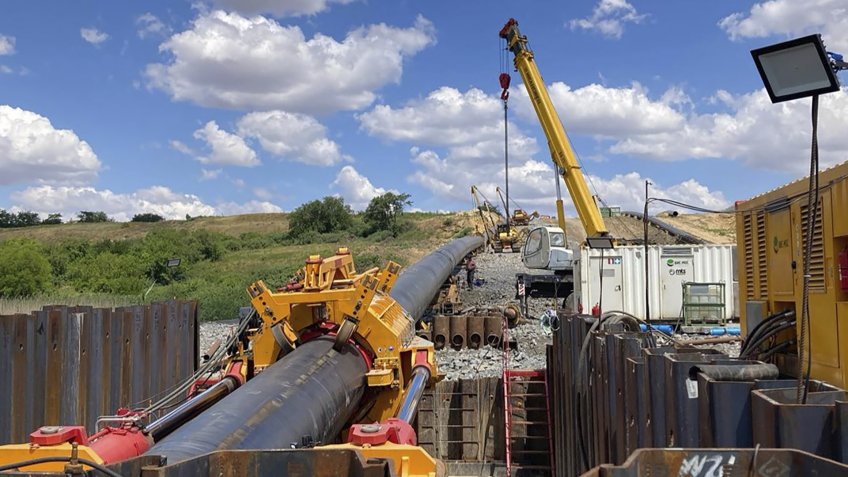
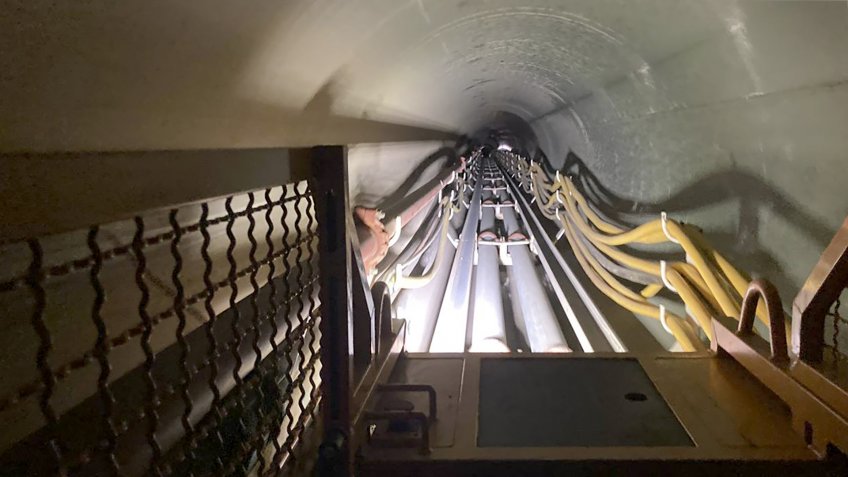
The students worked at all sections of the site for one and a half months, studying the entire process from multiple perspectives and at every stage—hydraulics, power supply, equipment, and separator units, which purify drilling fluid for water reuse.
- It was an incredibly interesting and unique experience for me. Some things were completely new, while others were already familiar. My position was assistant mechanic. During the internship, I learned to work with equipment such as tunnel boring machines, hydraulic systems, and drilling fluid purification systems. I'm glad I got to know this technology—I believe it should be further developed in Russia. These kinds of complexes are not produced here, despite the high demand, especially given the rapid metro and railway construction in cities, - says Irwan Zwageri.
The young man admits that he was initially worried about how well he would integrate into the new team and whether his background and non-native Russian language skills would be a barrier to fitting in. However, the transition turned out to be smooth, and his colleagues warmly welcomed him. In the end, he participated equally in discussions and problem-solving, working alongside the team to tackle tasks set by the site manager.
He also had no issues with pronunciation and understanding technical terms. The only challenge was dealing with local slang and Surzhyk (a mixed dialect incorporating elements of Ukrainian and Russian, widely spoken in Rostov), which contained many idiomatic expressions and words with double meanings.
- By the end of my internship, I was chatting with everyone as if I had been there for years, even joking like them. I think that’s the best indicator that I became part of the team, - Irwan recalls.
According to Dmitry Goryansky, the supervisor of the internship, he was very satisfied with the Mining University interns, noting that they demonstrated competence, initiative, and strong work ethics.
In fact, Irwan’s mentor became one of the scientific advisors for his thesis project, which the young specialist dedicated to the new technology used by Vis-Mos.

As Maria Vasilyeva, Associate Professor at the Department of Transport and Technological Machines, pointed out, practical training is where students gather materials and gain hands-on industrial experience.
- There are only a handful of specialists in this field in our country, so it's incredibly encouraging that our graduate was not only able to understand and work with this technology but also propose his own improvements. In his qualification work, he concludes that modernization is not just about improving immediate technical and economic performance. Modern realities dictate who we work with, what logistical chains we have, and what risks we face. Upgrading equipment should not be based on the principle of ‘I'll buy an equivalent’, but rather ‘I'll choose something not just as good but even better, ensuring reliable components and maintenance», - said Maria Vasilyeva.
Irwan admits that he is still uncertain about where he will build his career. However, joining a Russian company is a possibility—at the very least, Vis-Mos has already offered him a permanent position.
