

Less than two months remain until the awarding of diplomas at Russian universities. The labor market will be replenished with thousands of engineers, but not all of them will be in demand by multinational companies.
According to Sergey Gustov, the CEO of Gazprom Mezhregiongaz Group, the annual demand for graduates from universities and vocational schools is approximately 700 people. The company may hire bachelors, specialists, masters, and PhD holders, but their career prospects and the speed of career development are likely to differ. The Group's companies are looking for employees with in-depth professional knowledge and broad practical skills, as this is what ensures successful work outcomes. In an interview with Forpost, Viktor Ushanov, Deputy General Director for Technical Support of the Metrological Infrastructure at Gazprom Mezhregiongaz Engineering LLC, shared his personal experience and discussed whether employers themselves are involved in improving the skills of their staff and how to increase one's chances of success.

«I was born in the village of Krasnoye Solntse in the Bezhanitsky district of the Pskov region, with a population of just over 300 people. I have always been interested in natural resources: metals, minerals, and fuels. As a schoolboy, I came across an article online about Empress Catherine II Saint Petersburg Mining University, where they train advanced engineers who specialize in geological exploration, extraction, processing of raw materials, and all related processes. I delved deeper into the topic of resources, chose the specialty 'Design, Construction, and Operation of Oil and Gas Pipelines and Oil and Gas Storage Facilities,' graduated from school with a gold medal, and went to apply. Honestly, I didn't even consider other options – my priorities regarding the university and profession were clearly defined», – shared Viktor Mikhailovich.
In 2008, the Mining University was already actively collaborating with key mining companies in the educational and scientific fields. The university had modern classrooms and training facilities sponsored by companies like ALROSA, Lukoil, PhosAgro, and other players in the raw materials market. Viktor Ushanov recalls a laboratory that simulated the operation of a pumping station and allowed for the modeling of various production scenarios. The equipment presented there was something many oil engineers were not yet skilled in using, but the students successfully mastered it.
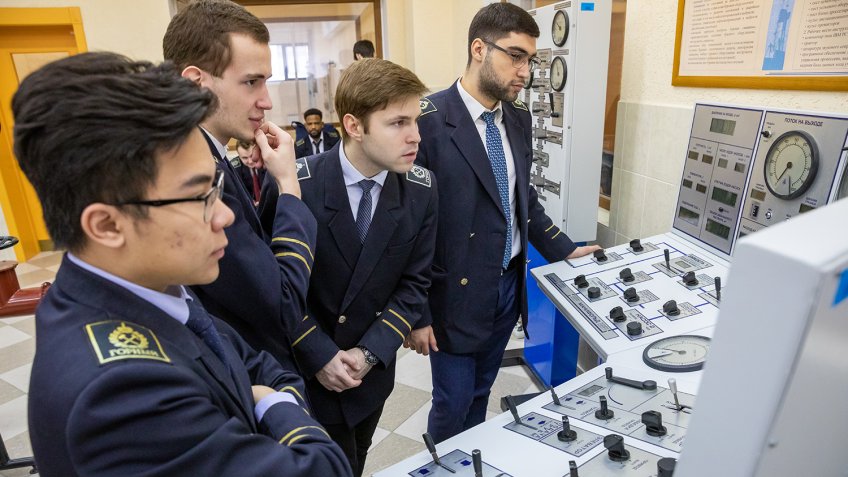
«It is important to make a crucial remark here: no matter how advanced the laboratories are, they cannot replace production practice. Only it allows you to immerse yourself in the real enterprise environment and hone practical skills. In my second year, I did my internship in Torzhok at a pipeline transport college. In the third year, I interned at Gazprom Gas Distribution in the Oryol region, where specialists explained the principles of operation in detail and familiarized me with the equipment used. In the fourth year, I found myself at Gazprom Transgaz Saint Petersburg at a compressor station in Veliky Novgorod, and there I had the opportunity to see with my own eyes how the system that ensures gas transportation across our country is arranged», – shared Viktor Mikhailovich.
At the beginning of 2025, the SuperJob service conducted a survey among graduates from 2022-2024 in various regions of the country. The survey showed that young specialists rated the difficulty of finding a job at an average of 6.6 points out of 10. The main obstacle cited by respondents was the lack of experience (59%). Other reasons included disappointment in the profession, difficulties with interviews, and the inability to combine work with further studies.
The pilot project for modernizing higher technical education, currently being implemented in Russia, aims to change this situation. It involves extending the duration of educational programs and production internships, as well as providing multiple vocational qualifications at the university level. This new engineering training system will automatically address the issue of the lack of initial experience and allow students to immerse themselves in their specialty before graduation.
«As for interviews, the main thing for an employer is to see that the candidate understands production processes, is capable of making well-founded technological decisions, and can handle unconventional situations. I still remember my first interview. When I applied for a position at the Engineering and Technical Center of Gazprom Transgaz Saint Petersburg, after a brief conversation about where and what I studied, the general director handed me a piece of paper and asked me to draw a typical compressor station layout. I remember his words when I finished: 'Great, I had no doubts!' Then, my positions and responsibilities changed, but the requirements, in essence, remained the same», – emphasized the speaker.
From the regional-level company Gazprom Transgaz Saint Petersburg, Viktor Ushanov moved to Gazprom Mezhregiongaz LLC, which unites 53 regional gas distribution companies and 67 gas distribution organizations. The Group ensures gas supply to all categories of consumers in the domestic market – from private homes in villages to large industrial facilities. The scope of activities covers the entire country, and the scale of tasks and the level of responsibility are commensurate. Viktor Ushanov, initially a leading specialist in the Automated Commercial Gas Metering System (ACGMS) and telemetry department of the ACGMS and Metrology Implementation and Operation Directorate, quickly rose to head of the department. In 2024, he was appointed Deputy General Director of the subsidiary Gazprom Mezhregiongaz Engineering».

«At my previous job, I was involved in the digitalization of gas metering. One of the key projects was the development of a nationwide program for the full equipping of consumers (except for households) with telemetry systems and smart gas metering devices. The goal was to improve gas metering, reduce losses during transportation and distribution. At my current position, I am responsible for this same program, which has been approved by PJSC Gazprom, but now from the implementation standpoint. In addition, my responsibilities cover two areas: the construction and maintenance of measurement tools and telemetry systems. While forming the team, I faced the challenge of finding, for example, a skilled designer for the design solutions department. There is always a choice between an experienced specialist with high salary expectations and a young graduate who is looking for a job strictly aligned with their diploma specialization but lacks experience. Unfortunately, recent university graduates often lack the skills and knowledge of the nuances of the profession», – said Viktor Ushanov.
According to him, there is a significant gap in the market between the requirements for young candidates and their expectations. Mining companies require highly qualified engineering and technical personnel. Most companies expect employees to possess broad competencies and unique experience that set them apart from their peers and allow for career advancement in the future.
«For a young specialist with ambitions, I would advise expanding their horizons and never stopping at just a higher education diploma. Companies often organize training centers within their structure. For example, in our holding, there is a rule that employees must upgrade their qualifications every three years. In Gazprom Mezhregiongaz Engineering, there is a Scientific and Educational Center that provides training for employees of all companies in the Group. The courses may focus on developing management competencies, acquiring in-depth technical knowledge, or learning software», –Viktor Mikhailovich explained.
Furthermore, businesses are seeking assistance from specialized universities. In October 2024, Gazprom Mezhregiongaz Engineering and Empress Catherine II Saint Petersburg Mining University signed a cooperation agreement in the educational and scientific fields. As part of this collaboration, the company plans to create a metrological laboratory at the university. It will feature digital systems and measuring devices for gas volume metering, which are used for gas supplies to both private consumers and industrial clients. The equipment will be integrated into the "Unified Control Panel for Telemetry Systems," developed by Gazprom Mezhregiongaz Engineering on its own software platform, IUSCIFRA.

«This approach to training will combine academic knowledge with real-world production tasks, helping students gain a deeper understanding of the material and see its practical application. Moreover, it will significantly simplify the adaptation of students to their first job. As a result, we will have specialists who are already speaking the same language as us and can quickly integrate into the work processes," summarized Viktor Ushanov.