

“Theory without practice is dead, practice without theory is blind.” These words belong to Alexander Suvorov and are hard to dispute. Nevertheless, the Bologna Process, implemented in Russia since the late 20th century and replacing the Soviet education system, came quite close to this imbalance. The transition to a two-tier system of “bachelor’s – master’s” degrees and the significant reduction of specialist programs nearly dismantled the country’s engineering training framework.
That is why, starting in May 2023, by decree of President Vladimir Putin, several universities began an experimental program aimed at improving technical education. In addition to the concept of an “educational core” — focused, in the first two years, on in-depth study of general education and general technical disciplines and the acquisition of additional competencies — the key emphasis of the “Pilot” project has been a significant increase in the share of practical training. This ranges from introductory internships to all forms of industrial placements, implemented through the “academic partners” program — a synergy between universities and industry. According to the Ministry of Science and Higher Education, Empress Catherine II Saint Petersburg Mining University has become a leader in building a working model.
Today, nearly one hundred companies across Russia host students from the Saint Petersburg Mining University at their facilities. The Union State is also keeping pace. Among the enterprises that have recently welcomed students for introductory internships are OJSC “BELAZ” — a global leader in mining equipment production; OJSC “Forging Plant of Heavy Stampings” — the largest manufacturer in the Republic of blanks, assemblies, and components for shaft-forming machinery; LLC “Eton” — a company producing electric transport systems for cities, trolleybuses based on MAZ buses, railway equipment, and hydraulic stations; the flagship of the Belarusian automotive industry, OJSC “MAZ”; and the agricultural machinery manufacturer OJSC “MTZ.” Fifty first-year economics students from the Mining University have just completed their internships at these enterprises. They were also hosted by technical colleges and by the university’s partner institution — the Belarusian National Technical University.


Anna Lyantseva:
«This week in Belarus, organized by the Mining University, completely changed my perception of engineering. It wasn’t just education — it was immersion into the living pulse of industry. It all began in the city of Zhodino, at the State and Polytechnic Colleges. We were shown laboratories and workshops where students acquire fundamental engineering skills. But the real excitement began at the enterprises. At OJSC ‘Forging Plant of Heavy Stampings,’ the roar of the 6,300-ton press — it’s a sound you feel in your bones! This plant transforms red-hot blanks into massive components with millimeter precision. In contrast, LLC ‘ETON’ offered a completely different atmosphere: quiet workshops dedicated to the development of power electronics. We were shown every stage of transport production. It was here that I realized the vital importance of what may seem like ‘invisible’ engineering — the kind that ensures everything else functions properly.
OJSC ‘Minsk Automobile Plant’ and OJSC ‘Minsk Tractor Works’ amazed us with the seamless coordination of their conveyor lines and engineering teams. In just one 8-hour shift, a bare chassis turns into a fully assembled vehicle!
What impressed me most was the production of ultra-heavy machinery — I’m talking about OJSC ‘BELAZ.’ What I saw there exceeded all expectations. This isn’t just a factory — it’s a kingdom of engineering titans. The colossal BELAZ-75711, a mining dump truck with a 450-ton load capacity! It’s an incredible experience to feel so small next to this giant. It’s not a machine — it’s a moving mountain! The fact that every BELAZ undergoes thousands of kilometers of testing before being shipped to the customer says one thing: reliability isn’t a slogan here — it’s a standard they build. The Mining University showed us the true scale of modern industry. I sincerely thank my alma mater! And a huge thank-you to Belarus for its hospitality and for giving us the chance to witness the industrial heart of the country!»

Maxim Kozlov:
«What stood out the most for me was the Forging Plant of Heavy Stampings — an enterprise that manufactures metal components of various shapes for different industrial sectors using multi-ton presses. We had guided tours around Minsk and the city of Zhodino, visited the Museum of the Great Patriotic War, and stayed at a wellness center. The internship left only positive impressions. Thanks to the joint efforts of the Mining University and Belarus, we gained insights into production processes at various enterprises and explored their economic dimensions. We had such a great time and grew so close to our classmates that, by the end of our stay, we didn’t want to leave!»

Kabasema Khoro Noé, Zimbabwe:
«The tour of the MTZ tractor plant gave me the opportunity to see models specifically designed for the Zimbabwean market, which demonstrated the adaptability and international reach of this industry. This immersive experience allowed me to witness the practical application of academic education — whether in technical drawing or other disciplines — within these leading industrial institutions. A perfect example of the synergy between theory and practice».

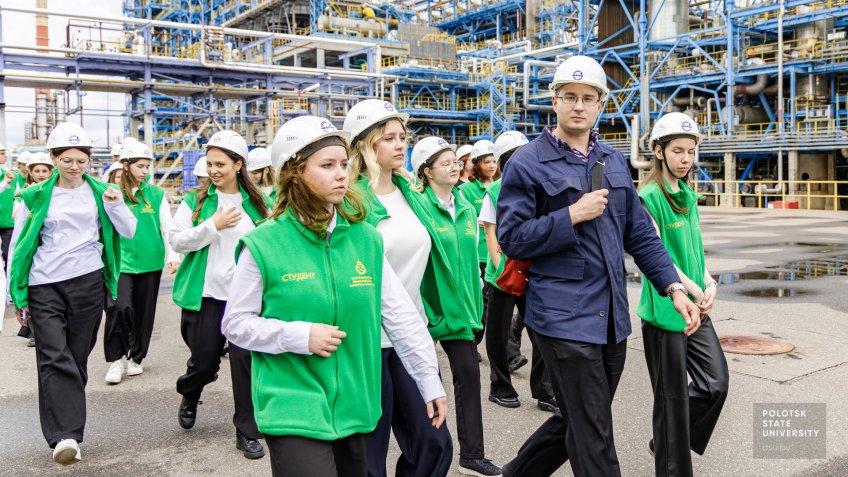
Technology students were welcomed by Polotsk State University named after Euphrosyne of Polotsk and OJSC “Naftan” — one of the leading enterprises in Belarus’s petrochemical industry. Here, the students from Saint Petersburg became acquainted with key technologies for oil processing. They studied primary oil refining units, diesel fuel hydrotreating, catalytic cracking, reforming, deasphalting, and dewaxing processes. In addition, they learned about sulfur recovery from hydrogen sulfide and observed the delayed coking unit in operation.
Lev Tarakanov:
«The trip to Belarus is an experience that every student of the Mining University will remember for a long time! It was a comprehensive program that included entertaining and educational excursions around the oldest city in Belarus — Polotsk. We spent three full days at the OJSC ‘Naftan’ and ‘Polymir’ facilities, and also participated in engaging sessions led by faculty members from Polotsk State University. As a result, I became even more confident that my field of study is exactly what I want to pursue».
Denis Zverev:
«Undoubtedly, our group was incredibly lucky to have Dmitry Sergeyevich as our guide. He accompanied the students during all visits to the plant’s units. As for me, I was especially impressed by the hydrotreating units, where the operators explained their work in great detail and with genuine enthusiasm. Of course, the plant itself left a strong impression on everyone. It’s hard to believe that such massive structures can be built by human hands».


Raykhana Nazmeeva:
«What stood out to me most was the tour of the historic building of PSU, where we were immersed in an atmosphere of history. We were amazed by the talking head — an interactive exhibit brought to life by the mechanism of Gabriel Huber — as well as the self-playing piano, which created a mystical ambiance. According to tradition, we tossed Belarusian coins into a wishing well to ensure we return someday. Equally fascinating was our visit to the Museum of Book Printing, where we learned about the evolution of printing, ancient books, and the first printing houses. We also visited the Saint Sophia Cathedral — an 11th-century architectural monument — and the Spaso-Euphrosyne Monastery, founded by Saint Euphrosyne of Polotsk in the 12th century».
Pavel Bratikov:
«The internship in Belarus left an indelible impression on me. I was especially struck by the Naftan oil refinery. It’s one thing to study a diagram of a delayed coking unit, and quite another to see it in person — it’s the size of a 35-story building. I definitely want to return there for an industrial internship».
Sergey Gryaznukhin:
«I was amazed by the sheer scale of the production — it turned out to be enormous. The most memorable part for me was the ELOU AVT-6 unit (atmospheric-vacuum distillation unit). It consists of an atmospheric block, a stabilization block, a secondary gasoline rectification block, and a vacuum block. The unit has a capacity of 6 million tons of oil per year — which is absolutely staggering».
Alina Kreuter:
«What impressed me most was the Polymir plant. It’s part of the chemical industry and operates as a division of the joint-stock company Naftan. The plant was built 50 years ago and began with polyethylene production, gradually expanding and evolving. Today, Polymir’s main products include polyethylene, PAN fiber, and polymer resins. It is either the leading or the only producer of these materials in the Republic of Belarus. The plant is divided into three operational sections: polyethylene production, monomer production, and synthetic fiber production. I was especially impressed that Polymir produces its own catalysts for monomer synthesis and even has a catalyst workshop where the base compounds are prepared».
Nadezhda Shchukina:
«Polymir is one of the largest chemical enterprises in Europe, producing polyethylene, PAN fiber, and polymer resins. Moreover, it is the only producer of polyacrylonitrile in the post-Soviet space. What impressed me most was the ammonia storage facility — around 1,000 tons. The plant produces 100 tons of PAN fiber per day, and 800 tons of raw materials in total daily. The polymerization of ethylene takes place in a tubular reactor at 2,000 atmospheres of pressure. For a first-year student, this is a valuable experience — a fantastic opportunity to learn more about one’s future profession and real industrial processes».