

At one time, river transport ceded its primacy to railways. Today, the fastest growth is seen in road transportation, which leads in terms of total freight volume. The quality and extent of road networks have long been among the key indicators of economic development for both countries and individual regions.
Road construction is a high-tech process in which every stage offers opportunities for innovative solutions — from improving asphalt concrete mixtures to applying digital modeling in infrastructure design. One of the industry leaders in Northwest Russia is the infrastructure holding ABZ-1.
The company’s history began in 1932 as the first specialized enterprise in the Northern Capital dedicated to the production of asphalt concrete mixes. Today, in addition to road construction and materials production, the group’s competencies include bridge design and construction, installation of engineering networks, and participation as a general contractor in major infrastructure projects such as the tram line in the southern suburbs of Saint Petersburg.
Innovation is a dedicated focus within the holding. It encompasses solutions aimed at increasing the service life of road surfaces and improving their operational performance. One of its recently patented inventions is a repair asphalt concrete mix whose composition enables it to quickly stabilize and gain strength under the influence of water — highly relevant for rainy Saint Petersburg.
Students are also involved in the company’s research activities. The practice of writing theses based on studies conducted in ABZ-1’s own laboratories has existed for more than 10 years.
ABZ-1 collaborates with Empress Catherine II Saint Petersburg Mining University under an academic partnership agreement, which provides for close involvement of the company in the educational process through continuous joint work with the specialized Department of Practical Skills and Experience. Company and university representatives jointly assess the level of professional skills acquired by students, organize the work of a qualification commission to evaluate retained knowledge, and attend thesis defenses. A new status — Industrial Mentor for Students — is being introduced for company employees working with interns.
In an interview with Forpost, Natalia Maidanova, Head of the Research Center of JSC ABZ-1 (part of the ABZ-1 Group of Companies), spoke about the company’s policy toward interns and young professionals.

– Natalia Vasilievna, the new model of engineering education that the Mining University is developing and implementing as part of the federal pilot project places significant emphasis on industrial internships. In your opinion, how important is it to strengthen the practical component of education?
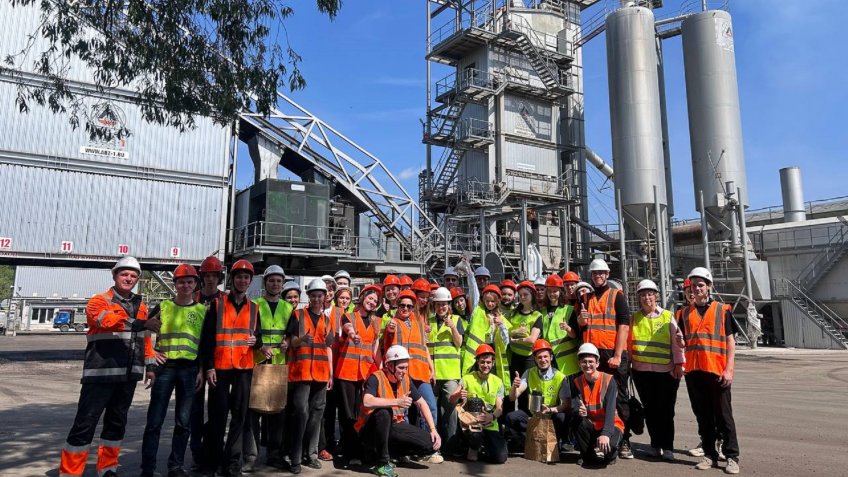
– Students need to be immersed in their specialty from the very first year, and this should not be limited to internships alone. I mean a comprehensive, year-round collaboration between the university and companies. This includes job fairs where employers from various sectors present themselves and their professions, helping students form a clear understanding of the industry where their knowledge will be in demand. It also includes production site visits, where students can delve deeper into the specifics, see the equipment they may potentially work with.
Our experience shows that genuine interest in the profession emerges after students complete an internship. Once annual industrial placements are introduced into the curriculum starting from the first year, we see how students’ engagement with the profession grows. By their second year, they are already connecting the theoretical knowledge they gain with what they have observed in the workplace. This provides strong motivation for their studies. It also helps address an important social issue: when students, after their initial years, radically change their career path or drop out altogether simply because they do not understand the purpose of their education.
When a student is familiar with the operations of a specific company, they even process industry news differently. Any sector-related update, layered upon knowledge gained in the field, helps shape a vision of a possible future and find one’s place in the profession.
When students are genuinely interested, they learn how to learn more quickly — and that is the most essential skill, not only for an engineer but for any modern person. This is the essence of lifelong learning: the world changes rapidly, and to adapt, one must constantly evolve.

– Students from which fields of study at the Mining University complete internships at your company?
– Where do the areas of our road construction company and the Mining University intersect? We work with mineral materials, and the properties and characteristics of the rock determine the quality of the road. The same applies to oil refining — one of its end products is bitumen. Bitumen is the base for the binder used not only in asphalt concrete mixtures but also in many other products applied in road construction: emulsions, mastics, sealants. In fact, these materials have a very wide range of uses in both road and civil engineering.
Just this year, we hosted an intern and master’s thesis student from the Mining University, Maria Volkova. She studied the effect of the chemical composition of mineral powders on asphalt concrete quality. We were very pleased with Maria’s work and her excellent thesis defense, so we hired her to join our Research Center as a First Category Laboratory Technician. And this is far from an isolated case — many students from Empress Catherine II Saint Petersburg Mining University come to us to complete their theses and then stay on as employees.
– What conditions does ABZ-1 create for interns?
– I’ll speak about the research and development side. ABZ-1 has several laboratories in St. Petersburg — both at production sites and a central one on Arsenalnaya Street, 66. All of them are equipped with the most modern equipment, and for a student, getting hands-on experience with it means gaining unique skills.
Most importantly, when students enter a plant laboratory, they can connect their work directly with the production cycle. They see the full picture: how materials are procured and delivered, how asphalt concrete mix designs are developed, how these designs are then adapted for production, and how the mixtures are laid on the roads. Interns come to understand that asphalt concrete is not just “something black and hot” — there is a lot of science, technology, and process behind it.
Each student is assigned a mentor from among the laboratory staff. This person’s role is more than simply helping with the work — they inspire, spark professional interest, and ignite curiosity. The goal is for students to develop an early passion for their field and, over time, a sense of loyalty to the company.
It is also worth noting that our internships are paid. Not every company offers this, but at ABZ-1 we pay interns 50,000 rubles per month.
– In your opinion, how important is it for a future engineer to acquire several working professions during their university studies?
– It is beneficial for any engineer to master multiple working skills. In the case of a laboratory, for example, this means the role of a lab technician. Such a specialist should know the basics of laboratory work, occupational safety, testing procedures, and methods for assessing the reliability of test results. This is the foundation — and the earlier a student masters it, the easier and more engaging their learning process will be.
Engineers are future managers. To set tasks correctly, distribute workloads effectively, and organize workflows efficiently, it is ideal to have gone through all the stages of the production cycle. That requires understanding what it is like to, for instance, operate a loader or work on a production line — and seeing firsthand what could be improved or optimized.

– How high is the demand today for research engineers, and what is the need for technological innovation?
– Every country needs to build up its technological potential, and that is precisely the task of research engineers. At present, innovation is in demand in absolutely every field. Companies that do not invest in their own development, fail to research new technologies, and avoid implementing them in production are doomed. In the road construction sector, for instance, competition is extremely high. That is why it is essential to stay at the cutting edge of technology and offer the market something new — that is the key to success. In this regard, research engineers are more in demand than ever.
– What competencies do you expect from young specialists first and foremost?
– First, a graduate should have a solid basic engineering education. This is the foundation on which industry-specific knowledge and other skills will be built. Second, proficiency in working with artificial intelligence is important. Here I must emphasize: AI does not replace human intelligence; it acts as an assistant for data collection, analysis, and determining research directions. Third, an essential requirement is the ability to work with regulatory and legal documentation — GOST standards, directives, orders, instructions, technical regulations. A young specialist must understand the importance of these documents and organize work in accordance with them.
– What specialists does your company need today?
– Any industrial partner will tell you that engineering professionals are always in demand. In our case, this includes research engineers, mechanical engineers, civil engineers, and bridge construction engineers.
Student job postings can be found in the ABZ-1 Group’s VKontakte page, while the full list of vacancies is available on the company’s profile on hh.ru.