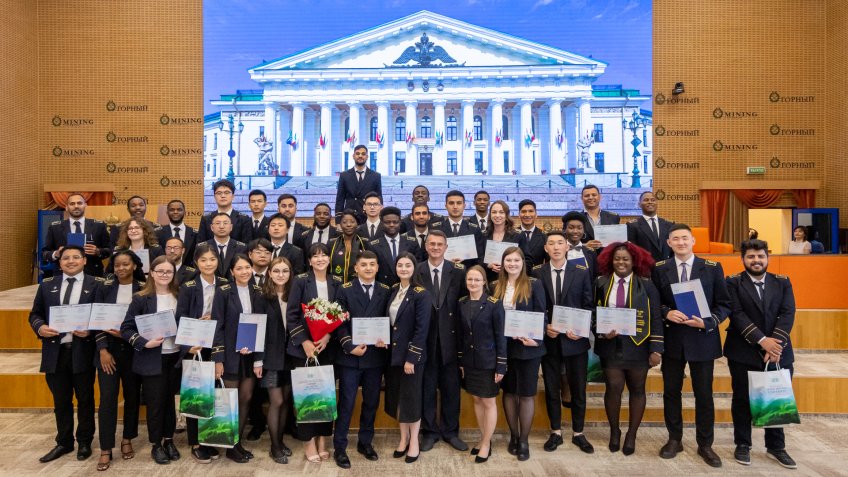

Why should African students study ecology and petroleum engineering in Russian universities? Why do Chinese students come to Saint Petersburg to study economics? And most importantly, why does our country need this?
Already on Monday, the classrooms and laboratories of universities will be filled with young people eager to acquire new knowledge and competencies. This year, a total of 442,000 spots were allocated for first-year students. In addition to our own citizens, foreign students also entered on government-funded quotas. Each year, 30,000 such “places” are allocated. However, more than two-thirds of international students still enroll on a commercial basis, which best demonstrates the strong demand for Russian higher education.
Despite the Special Military Operation, difficulties with logistics and bank transfers, and the requirement to learn Russian, the percentage of international first-year students has steadily increased year after year. In 2024, Russian universities hosted 389,000 foreign students. This year, the figure announced is 410,000. But this is not the limit. According to the Unified Plan for Achieving the National Development Goals, approved in early 2025 by Prime Minister Mikhail Mishustin, by 2030 the number of international students should reach 500,000.
Predictably, the list of countries sending young people to Russia has changed. The share of students from Europe has decreased, while the number of applicants from China, Vietnam, India, Africa, the CIS, and the Middle East has grown significantly. For example, the number of Iranian students in 2025 reached 9,210, which is 42% more compared to 2023. To reach the target of half a million students, it is necessary to continue actively expanding international cooperation.
For instance, strengthening inter-university collaboration was the focus of the working visit of the Minister of Science and Higher Education of the Russian Federation, Valery Falkov, to China and his meeting with the Minister of Education, Huai Jinpeng, in Beijing on August 25, 2025.
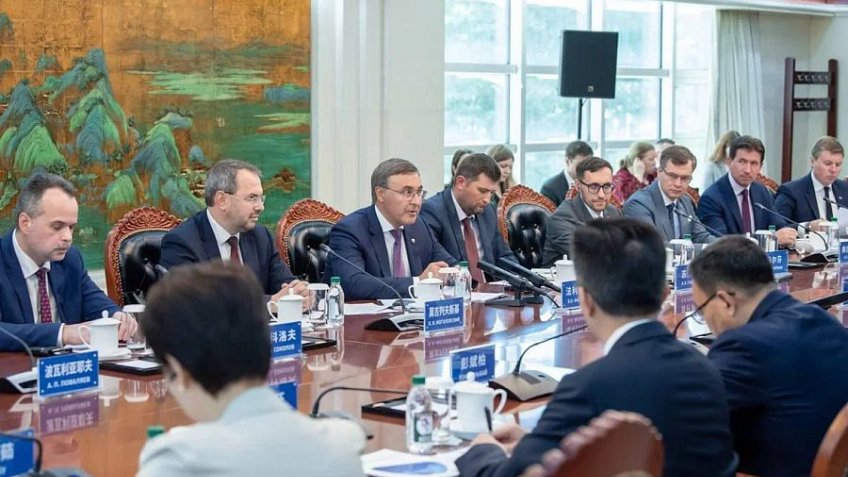
The parties reviewed the planned joint Russian-Chinese universities. One of these strategically important projects, which is currently under discussion, is the Russian-Chinese University of Mineral Resources, initiated by Empress Catherine II Saint Petersburg Mining University. On the Chinese side, Taiyuan University of Technology has expressed interest in participating. Huai Jinpeng emphasized that this project is supported by China and should be elaborated in the near future.

«This year I graduated from high school in Beijing and enrolled in the program Economics of the Resource Sector. Russia has outstanding achievements in mineral resource engineering. Empress Catherine II Saint Petersburg Mining University is a leader in this field, and its program fully aligns with my development goals. My desire to study the interaction between the mining industry and the global economy, the university’s strong program in this area, and its practical opportunities played a key role in my choice of where to study. Admission required careful preparation — collecting documents, passing language tests, and achieving a high school diploma with strong grades. But I am confident that I will receive a high-quality education here. My parents fully support me, they know about the university’s reputation and believe that an overseas education will broaden my horizons and provide unique knowledge. My friends admire this idea, considering it an excellent career opportunity», - said first-year student Li Boqiao from China.

The young student admitted that before the start of his studies, he felt a mixture of euphoria and nervousness. He hopes to gain profound knowledge in mining engineering, make friends from different countries, and develop his leadership and communication skills.
«I am glad to be starting a ‘new chapter’ at a renowned university, but I worry whether I will be able to cope with the language and academic workload. Today, the Mining University is implementing a new system of higher engineering education, which moves away from the Bologna process, extends the period of study to six years, and increases the number of hours devoted to industrial training. This is an interesting and important innovation, which will allow for a deeper study of disciplines and better development of practical skills. I hope I will be able to adapt quickly to the extended study process», - says Li Boqiao.
For several years now, engineering and technical specialties have been among the most popular choices for international applicants.
Nicolás Enrique Chavarría Ferrúa from Peru enrolled as a first-year student at the Faculty of Oil and Gas.

«In Peru, the situation with education is very poor, both in universities and schools. So far, our government and politicians have failed to raise it even to the average general level of South America. As a result, despite the country’s large reserves of natural resources — gold, copper, silver, oil, and natural gas — we are highly dependent on foreign investment and qualified personnel. Peruvian legislation is aimed at providing investors with increasingly favorable conditions for exploration and extraction contracts. Therefore, I had to study petroleum engineering abroad. I love Russia very much; since childhood I have been interested in its history, watched films, and read books about the Russian Empire and the USSR. Studying here has always been my dream, and now it has come true», - shares Nicolás.
The young man received a quota from the Government of the Russian Federation and chose among specialized universities. This was how he first learned about the Mining University and decided to apply.
«This is the oldest engineering university in the country, with an incredible history. That is so inspiring! At first, my family did not approve of the idea: my parents were very worried about the change of climate, as well as the events in Ukraine. But they studied the matter carefully and agreed with my choice: ‘If this is what you truly want, then go for it!’ I am glad about the changes now taking place at the Mining University and its participation in the pilot project, because this will make me a stronger engineer. That is why I came to Russia. I believe that the oil and gas industry and the mining sector are not only about economics, but also an effective political instrument. Therefore, knowledge in the field of resource extraction will be strategically important not only for my career but also for my country as a whole», - Peruvian emphasizes.
International students also come to study in Russia thanks to what is often called “word of mouth.” Their relatives, friends, and acquaintances once studied here and, upon returning home, preserved warm memories of their student years for decades. They achieved success and now recommend that younger family members follow in their footsteps. This trend is especially typical for African countries, whose citizens were admitted in large numbers to Soviet universities.
Monica Lungu from Malawi came to Saint Petersburg on the advice of her father, who had studied engineering back in the Soviet Union:

«He is very glad that I managed to pass the entrance exams to the Faculty of Mining, where I will study geoecology. In my regular secondary school class in Lilongwe, there were 50 students, and only a small portion of them decided to pursue higher education. The issue of environmental protection is highly relevant both for Africa and for the world as a whole. The Mining University has a strong program in the field of environmental management, the development of environmentally friendly technologies for the extraction and processing of mineral resources, and the disposal of industrial waste. Your country offers wide opportunities for international students — state-funded quotas, participation in international forums, industrial training, and most importantly, high-quality education».
A large percentage of international first-year students come from CIS countries and former Soviet republics — Kazakhstan, Uzbekistan, Turkmenistan, Tajikistan, Belarus, and Kyrgyzstan.
«I came from Shymkent, the third most populous city in Kazakhstan. In our republic, 160 fields have been explored, with reserves of more than 2.7 billion tons of oil. Experts believe that in the Caspian coastal region, there may be another 3.5 billion tons of oil and 2.5 billion cubic meters of gas. Their exploration and extraction require highly competent mining engineers, yet training in Kazakhstan leaves much to be desired. For me, it is important to study oil and gas engineering in a country that plays a major role in global geopolitics and has extensive experience in resource development. Russia was the solution», - explained Igor Petrikov, a first-year student at the Faculty of Oil and Gas of the Mining University.

Igor’s mother also came to Saint Petersburg — to help her son settle in and to introduce him to the city where she herself once studied, at the Hydrometeorological University. Receiving an education in Russia has, in a sense, become a family tradition.
«To be honest, we were initially opposed to our son’s choice of profession. We are an aviation family. My husband is a pilot, I am a meteorologist at the airport, and our daughter is currently studying to become an air traffic controller at the Saint Petersburg State University of Civil Aviation. We expected that our son would follow in our footsteps and become a pilot. Igor’s decision came as a complete surprise. Over time, however, his determination only grew stronger, and we began looking for a university. That was how we learned about the Mining University, its high standards, and the career prospects of its graduates. As a result, we are now fully supporting our child on his path toward his dream. It turns out that people also work on the ground!» - jokes Irina Petrikova.
A major role in attracting young international students is played by the targeted efforts of the universities themselves. These include international youth forums, internships such as “summer/winter schools,” and participation in educational exhibitions abroad to promote Russian education. Just in the past academic year, the Mining University took part in such outreach events in Oman, Tanzania, Serbia, and many other countries. As a result, of the 10,000 students enrolled at the university, about 1,000 are international.
After graduation, they will have two paths: to stay or to leave. For the Russian Federation, both outcomes are beneficial. In the first case, the country gains highly qualified specialists; in the second, it gains an instrument of “soft power” — ambassadors of its ideas and interests.