

The September visit of the delegation from Empress Catherine II Saint Petersburg Mining University to China, aimed at selecting partners for joint projects, was focused on three fundamental areas. The first was the alignment of China’s educational system with the core principles of the Pilot Project; the second was ideological resonance, meaning the methodology of educational and formative activities; and, of course, the third was science.
Anyone visiting modern China for the first time inevitably wonders how a once predominantly agrarian country has managed to transform into the world’s leading industrial economy. Between 1996 and 2024, the nation’s GDP grew from 511 billion USD to 18.76 trillion USD. Two-thirds of the cars on its streets are powered by electricity; at intersections, two robots may “argue” over who must yield the right of way; in key regions, high-speed 5G networks have long been operational; and in remote rural provinces, thousands of drones deliver goods.


The foundation of these “miracles” is science, and one of its essential components is international innovative cooperation. China is seeking partners, China is interested in partners, and the slogan “Together we are stronger” is not an empty phrase here but one that yields tangible results.
Empress Catherine II Saint Petersburg Mining University is steadily intensifying the implementation of joint research projects with several Chinese universities. In the field of Mining Engineering, a number of growth points have already been established with Taiyuan University of Technology, located in Shanxi Province. This region is known as the “Coal Sea of China” — it accounts for 37% of the country’s total coal production.

However, the focus of local scholars is not limited to optimizing approaches to coal mining. The university also plays an important role in addressing research challenges related to the study of Antarctica.


«Taiyuan University of Technology has made a significant contribution to the establishment of scientific stations on the Sixth Continent and plays an important role in their operations. Initially, we worked on automated equipment for monitoring parameters such as temperature and other climatic conditions. However, over the past four to five years, our team has focused on solving the problem of green energy for polar stations. I serve as the chief national scientific supervisor for the development and use of clean energy technologies in extreme environmental conditions. Accordingly, TYUT is the leading scientific institution on this issue. The clean energy system for China’s newest Antarctic research station, Qinling, was designed and developed by our university team. Gradually, this system will be introduced at Zhongshan, Great Wall, and other stations. Previously, many of them relied on diesel fuel as a traditional energy source, but today, we are transitioning to new sustainable sources. The environment at the bases is extremely cold, and transporting fossil fuels to such remote locations is both costly and unsustainable. Moreover, their use has a negative impact on the environment», - said University Rector Sun Hongbin, who also serves as Chief Scientific Officer for Clean Energy at the Polar Research Institute of China.

Qinling is located in the Ross Sea region and is China’s fifth Antarctic station. Its uniqueness lies in the fact that it became the first on the continent to launch a hybrid energy system combining wind power, solar energy, and hydrogen fuel cells. This system was developed by Taiyuan University of Technology in collaboration with a hydrogen energy technology company under China’s State Power Investment Corporation. According to Chinese experts, the applied approach ensures a stable power supply under conditions of months-long darkness and extreme cold, while also reducing reliance on fossil fuels by more than 100 tons per year.

The experience of Russia’s oldest technical university in the comprehensive study of Antarctica is difficult to overestimate. More than half a century ago — in the late 1960s — specialists from the Mining University began drilling glaciers on the Sixth Continent.

The Vostok Station is the coldest point on Earth. And it was the scientists from Saint Petersburg who managed to drill five deep wells there, extract more than 10,000 meters of core, and set several world records in glacial drilling. The deepest well penetrated Lake Vostok at a depth of more than 3,700 meters.
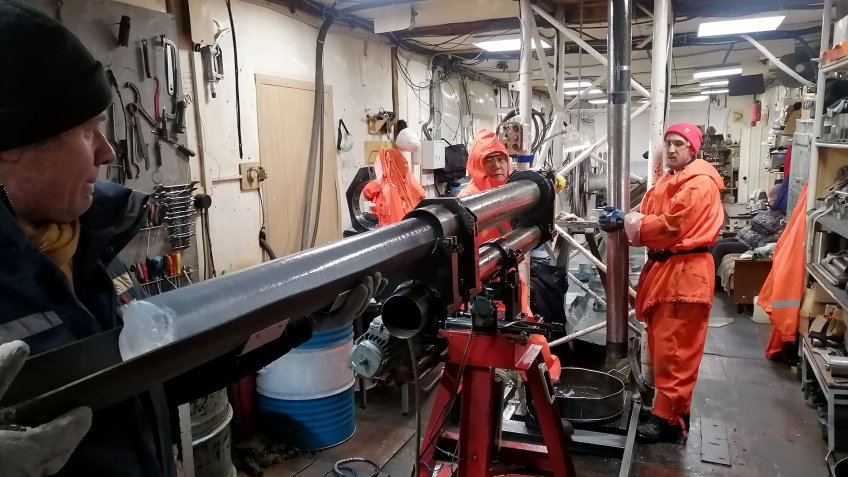

Within the university, the extracted material is analyzed, and unique experimental stands are used to study the processes occurring during the drilling of glaciers and rocks by various methods. Based on the results of the expeditions, work is underway to develop environmentally friendly technologies for drilling glaciers and subglacial formations. At its own technological site, the university is assembling a new drilling complex to carry out operations at the coastal Progress Station.

Today, the Saint Petersburg University is setting metageological objectives aimed at expanding knowledge about energy sources, the deep structure and thermal field of the Earth, obtaining practical confirmation of studies on the role of molecular and atomic hydrogen in global diffusion seepage, as well as forecasting the presence of new extractable deep hydrocarbon and ore deposits.
«Considering Russia’s achievements in Antarctica and the Arctic, particularly those of scientists from Empress Catherine II Saint Petersburg Mining University at the Vostok and Progress stations, I believe that the subject of the North and South Poles is an excellent focal point for scientific cooperation, perhaps more important than all the others. Together, our countries can make an even greater contribution to their study and sustainable development. We can develop a plan of joint scientific research activities or even consider the possibility of creating a joint research institute. Such a scientific program would certainly receive the support of both governments and spark great interest among scientists themselves, since they will be able to exchange knowledge and experience on common problems that humanity must address in the future. This kind of cooperation could ultimately become a model for other strong engineering universities in China and Russia», - noted the Rector of TYUT.


In the field of deep drilling, the China University of Petroleum (UPC) in Qingdao has also expressed interest in cooperating with the Mining University. The two institutions share many closely related scientific areas, but in regard to deep metadrilling technologies, their collaboration may prove to be the most promising.

In June 2025, during her visit to the Mining University, UPC Vice President Dai Caili expressed confidence “that cooperation between our working teams in this field will be in great demand for both countries..

Research directions in Qingdao include the formation of deep oil and gas reservoirs, their geophysical forecasting and intelligent identification, drilling materials and equipment for deepwater production, and the efficient development of deep deposits. Each of these areas is divided into dozens of critical topics, such as assessing the potential of ancient source rocks, deep sources of oil and gas, the evolution of hydrocarbon phases, rock physics under high-temperature conditions, technologies for ultra-deep rock fracturing, and many others.


The research results of the China University of Petroleum were applied in the construction of two of China’s ultra-deep wells. For “A1H” in the Pearl River estuary (2024) and “Shenjitake-1” in the Tarim Basin (2025), the university carried out logging and geophysical studies.
A1H became the deepest offshore well, setting a record in horizontal drilling, and was the first in China to be independently designed and constructed with a large deviation from the vertical. Building a new offshore platform for the relatively small reserves of the Enping 21-4 field was economically impractical. Therefore, the choice was made in favor of technology involving wells with a long horizontal displacement drilled from a nearby platform. The wellbore length reached 9,508 meters, with a deviation of 8,689 meters from vertical, and an oil output of more than 700 tons per day.
Shenjitake-1 became the first deep vertical well in the Asian region and the second deepest in the world. Its depth reached 10.9 thousand meters in the Tarim Basin. In addition to the search for oil and gas resources, the well is intended for studying the Earth’s evolution and deep geology. Drilling confirmed that the Tarim Basin holds potential oil and gas resources at a depth of 10,000 meters. The well penetrated 12 geological formations, reaching layers dating back 540 million years.

At UPC, a leading national laboratory has been established, where research is conducted and students undergo practical training. The scientific center’s facilities make it possible to drill experimental wells up to 200 meters deep directly on campus and to carry out geophysical work at depths of up to 70 meters from the wellhead.

«At our university, similar work is carried out at the ‘Sablino’ educational and research training ground, where three training and testing well models are in operation — two vertical and one directional. Students acquire practical skills in conditions as close to reality as possible. As for scientific research, studies in this field are being conducted simultaneously in several research centers. At the Arctic Research Center, formulations of drilling fluids and cementing compounds are being developed, as well as equipment for creating ultra-deep wells. At the Research Center for Geomechanics and Mining Problems, the physical and mechanical properties of rocks are studied, along with modeling of the most probable schemes of geodynamic phenomena in relation to the conditions of the adopted system of mineral deposit development», - explained Dmitry Tananykhin, Vice-Rector of the Mining University.


As part of the Mining University’s program for the in-depth study of the genesis of typical Earth structures, the drilling of an ultra-deep well in the Timan-Pechora petroleum province is planned, with a projected depth of 8,000 meters. Current technologies make it possible to install sensors capable of detecting the presence of mineral deposits at great depths. An equally important objective of the project is to confirm the theory of the abiogenic origin of hydrocarbons.


«We pay such great attention to research in this area because exploration and development at shallow depths are already highly advanced, and future results there are relatively clear and predictable. At deeper levels, however, the degree of exploration remains quite low and represents significant interest both for scientists and for oil and gas companies. The China University of Petroleum began research on deep formations relatively recently, around 2017. At present, international cooperation in the field of ultra-deep drilling is limited to isolated contacts between professors and has not yet become organized and systematic. In Russia, drilling technologies are of a very high level, and the record for the deepest drilling still belongs here. That is why we are particularly interested in mutually beneficial cooperation with you. Our universities can collaborate through international joint laboratories, joint project implementation and personnel training, knowledge exchange among specialists, as well as the organization of international conferences. For example, in October, we plan to hold in Qingdao the first forum dedicated to oil and gas at great depths», - noted Professor Yang Yunfei, head of deep drilling research at UPC.
