
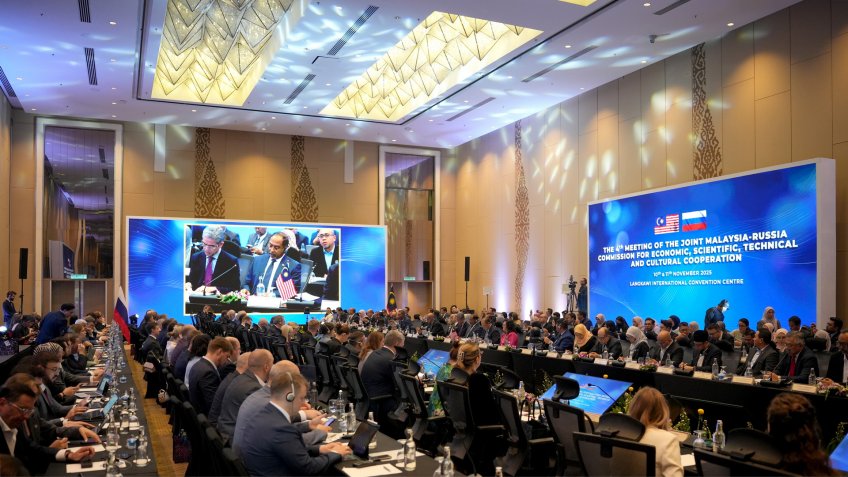
On Langkawi Island in Malaysia, the fourth meeting of the Joint Russia–Malaysia Commission on Economic, Scientific-Technical, and Cultural Cooperation was held. In addition to the preliminary results of interaction between the two countries for 2025, the parties discussed upcoming events and a whole list of areas of mutual interest: from the Russia–Malaysia Raw Materials Forum to the peaceful use of atomic energy and the import of Russian technologies.
The co-chairs of the meeting of the Russia–Malaysia intergovernmental commission were the Minister of Science and Higher Education Valery Falkov and Malaysia’s Minister of Higher Education Zambri Abdul Kadir. Among the results of cooperation between the countries this year alone were a 32% increase in trade turnover, an increase in trade in chemical industry products—the export of Russian fertilizers jumped by 124%—as well as an agreement on cooperation among dozens of universities and companies of both states.

Zambri Abdul Kadir noted that the 4th session of the Intergovernmental Commission marks significant progress in strengthening bilateral relations between Russia and Malaysia, which are based on many years of friendship, mutual respect, and shared aspirations.
«This cooperation not only strengthens the spheres of higher education, science, and technology, but also opens up opportunities in energy, the halal industry, Islamic finance, and green technologies, which benefit the peoples of both countries», — he said.
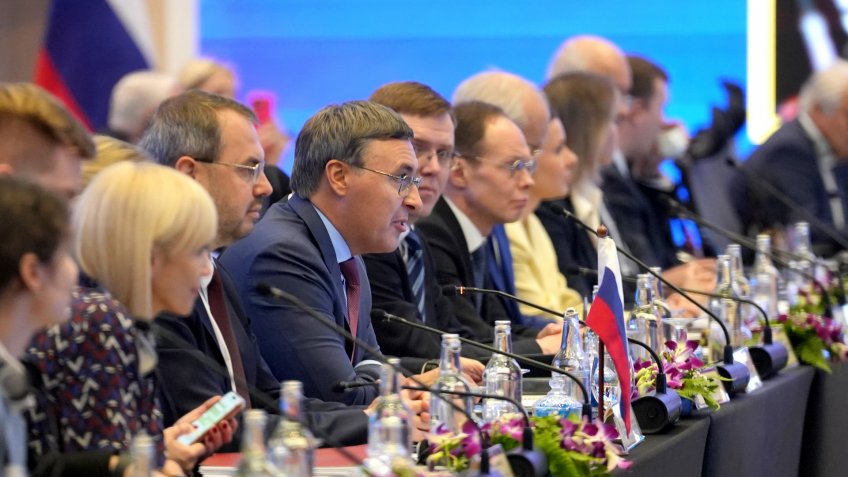
The head of the Ministry of Science and Higher Education, Valery Falkov, also outlined mutually beneficial milestones.
«We see active interest on the part of businesses in both countries in increasing trade in products, arranging supplies of Russian LNG to Malaysia, and maintaining stable fertilizer supplies to support Malaysia’s rapidly developing agricultural sector», — he said.
A whole list of areas and plans was presented at the event. The list included industrial roadmaps, the financial sphere, banking cooperation, as well as scientific and technical interaction. Malaysia and Russia intend to continue the joint implementation of a pilot project on power supply and the energy application of nuclear power, to hold seminars for the exchange of knowledge and technical expertise in the transport sector, and to exchange experience in the field of cybersecurity. In the field of science and education, the continuation of scholarship payments to Malaysian students for study in Russia and the possibility of joint applications for research projects were noted.
One of the central topics of the meeting of the Intergovernmental Commission was the agreement to hold the Russia–Malaysia Raw Materials Dialogue in St. Petersburg in the third quarter of 2026. Valery Falkov noted that this forum is the most important stage in the interaction between the two countries, and that the mineral resources sector made the main contribution to the volume of trade turnover between Russia and Malaysia this year.

On November 10, the delegation of Empress Catherine II Saint Petersburg Mining University agreed to hold the first Russia–Malaysia Raw Materials Dialogue in St. Petersburg in autumn 2026. The idea of organizing such a platform was put forward in October 2024 by the Rector of the Saint Petersburg Mining University, Vladimir Litvinenko, at the third meeting of the Intergovernmental Commission. The initiative was supported by Malaysia’s Minister of Higher Education, Zambri Abdul Kadir.
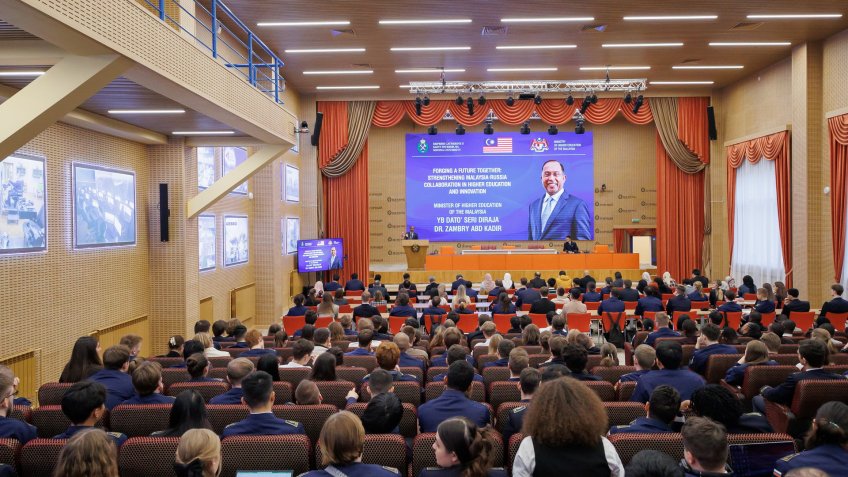
In 2025, Empress Catherine II Saint Petersburg Mining University and the University of Malaya—one of Malaysia’s leading and oldest universities, as well as a partner university for the Russia–Malaysia Forum—held a series of online seminars. Scholars of the Mining University presented reports by its leading scientists on the oil and gas sector, the extraction and use of rare earth metals, and geological exploration. Scholars of the University of Malaya delivered reports on the country’s oil resources, the development of supply chains for rare earth metals, and the research initiatives of the Center for Entrepreneurship in the field of gold, rare earths, and materials.

Vice-Rector of Empress Catherine II Saint Petersburg Mining University Evgeny Lyubin noted that the main outcome of the meeting of the Organizing Committee for preparing the Raw Materials Dialogue and of the session of the Intergovernmental Commission was the parties’ agreement that the forum goes far beyond academic exchange, since its goal is to create a large-scale business and governmental platform. It will unite the efforts of Russia and Malaysia to solve strategic tasks in the mineral resources and fuel-and-energy complexes, creating new growth points for the economies of the two countries. The platform will be unique, since within its framework all key players will gather at one table—from representatives of the relevant ministries and agencies of both countries to the heads of the largest companies, leading scholars, and university rectors. This format will make it possible to establish a direct and effective dialogue, bypassing multilevel bureaucratic barriers, and therefore the resolution of complex issues, whether the alignment of standards or the entry of companies into new markets, can be accelerated significantly, the Vice-Rector emphasized.

In practice, the Dialogue will enable Russia and Malaysia to harmonize legislation, jointly develop proposals to align their regulatory and legal frameworks, so that the work of companies in the raw-materials sector becomes simpler and more transparent, and to objectively identify mutual priorities, added Evgeny Lyubin.
«It is about determining which projects—whether the exploration of new deposits, the development of oil refining, the implementation of 'green' technologies in the fuel and energy complex, or cooperation in the sphere of critical minerals—are the most advantageous and promising for both countries. Furthermore, within the framework of the Raw Materials Dialogue, concrete projects that receive support at the state level will become a magnet for investment from companies in the mineral resources sector of Russia and Malaysia», — he explained.

According to Lyubin, the universities themselves will be an important part of the process—in the framework of the Dialogue they will be responsible not only for traditional academic exchange, but also for building large-scale cooperation. Thus, joint educational programs, exchanges of students and graduate students, internships, and the creation of international research teams will be purposefully oriented toward training personnel and conducting research and development (R&D) for those very priority projects that will be determined by both sides. As a result, the student or researcher will be engaged in what is truly in demand by the economies of the two countries, and his work will find direct application with partner companies, the Vice-Rector noted.

«To ensure that all this work is not limited to annual conferences but is carried out on an ongoing basis, thematic working groups are already being formed. Each such group will focus on its own strategic area, such as ‘Oil, Gas and Energy of the Transition Period,’ ‘Mineral Resources and Geology,’ or ‘Science, Innovation, and Personnel Training.’ Their tasks are extremely specific and pragmatic—to form a list of priority topics, develop roadmaps for their implementation, and, on a continuing basis, coordinate actions among business, science, and the state. It is expected that the heads of the groups from the Malaysian side will be appointed in the near future, after which their Russian colleagues will be able to begin active joint work», — said Evgeny Lyubin.

The Vice-Rector added that the next stages of interaction between the countries within the framework of the Raw Materials Dialogue are the coordination of the dates and the composition of participants in the meeting of the organizing committee in St. Petersburg, the launch of working groups, and the beginning of practical work on projects that will strengthen the economic partnership of Russia and Malaysia on a long-term basis.

Deputy Minister of Energy of Russia Roman Marshavin, within the framework of the meeting, noted the key areas of energy cooperation with Malaysia: cooperation in the field of standardization and conformity assessment of oil and gas equipment and in the field of geological exploration. The parties also discussed the exchange of experience in renewable energy sources. Roman Marshavin noted that Russian companies are open to cooperation with Malaysian companies in performing offshore and onshore geological exploration work, and can also take part in projects for the reconstruction and modernization of a Malaysian hydroelectric power plant (HPP).


Following the meeting, the parties approved the minutes of the event and concluded a number of new agreements on scientific and educational cooperation. The first copies of the memorandum were exchanged by representatives of Empress Catherine II Saint Petersburg Mining University, and the University of Malaya; the document is devoted to the development of the Raw Materials Dialogue, as well as to the partnership of the two universities in the scientific and educational sphere. Among the main areas of joint work to be carried out within the framework of the Raw Materials Dialogue are geological exploration, the extraction and processing of mineral resources, the development of rare earth metals, the introduction of new technologies, and the training of qualified personnel.

A total of 39 agreements were signed between universities and scientific organizations of Russia and Malaysia within the framework of the meeting. Thus, the total number of agreements exceeded 150.

Malaysia, a constitutional monarchy, is one of the leaders in the Asia–Pacific region (APR) in the extraction of hydrocarbon resources; the country’s commercial oil and gas reserves are estimated at 17 billion barrels of oil equivalent (boe), and it ranks fifth in the world in the production of liquefied natural gas (LNG). Malaysia also possesses some of the largest deposits of tin, bauxite, iron ore, coal, and copper. Industrial minerals are mined in the country, such as clay, kaolin, silica, limestone, barite, and phosphates.
The partner university of the Mining University for the Russia–Malaysia Raw Materials Forum, the University of Malaya (UM), is Malaysia’s leading university. It is in 60th place in the QS World University Rankings 2025, ranks in the top 100 for 20 subjects, and in the Top 50 for four subjects in the QS World University Rankings.
Prepared with the assistance of the Competence Center for Mining Engineering Education under the auspices of UNESCO.