
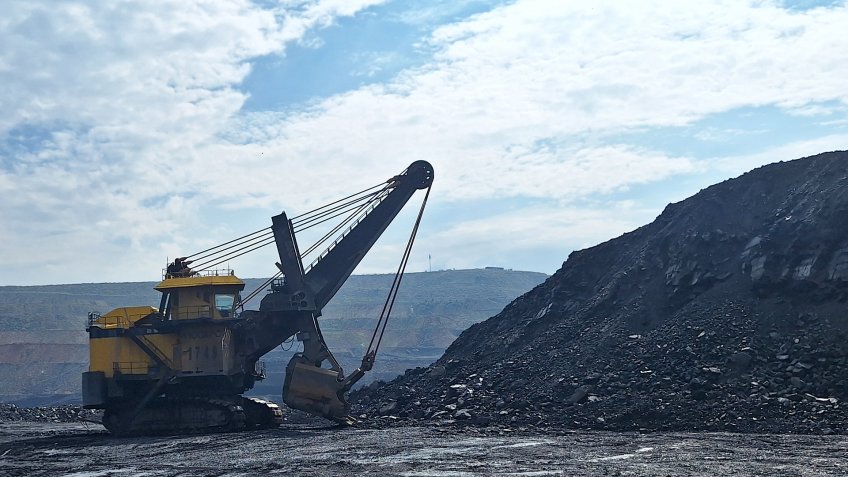
Despite the Western initiative to phase out fossil fuels, coal remains a strategic asset for the financial and industrial security of many countries. China’s open-pit coal mines are among the most sought-after destinations for international specialists in the mineral resources sector. For them, seeing first-hand the technologies used to develop deposits in the world’s leading coal-producing country is far more significant than simply visiting the Great Wall of China or the Forbidden City.
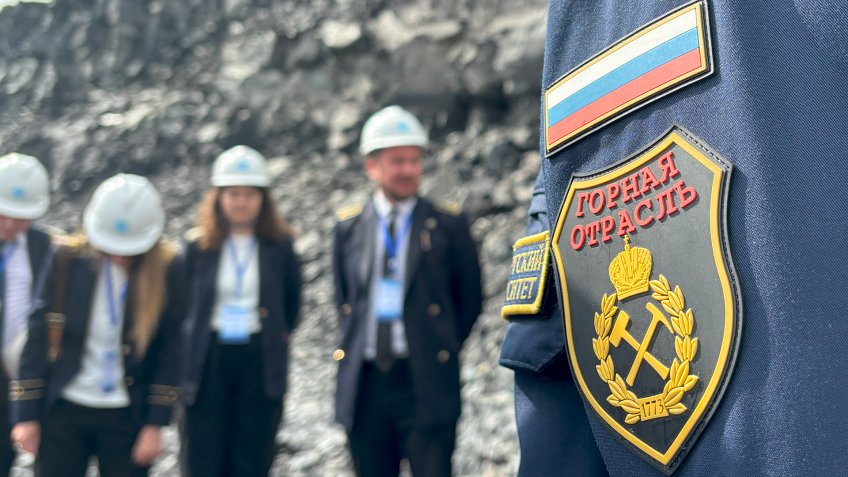
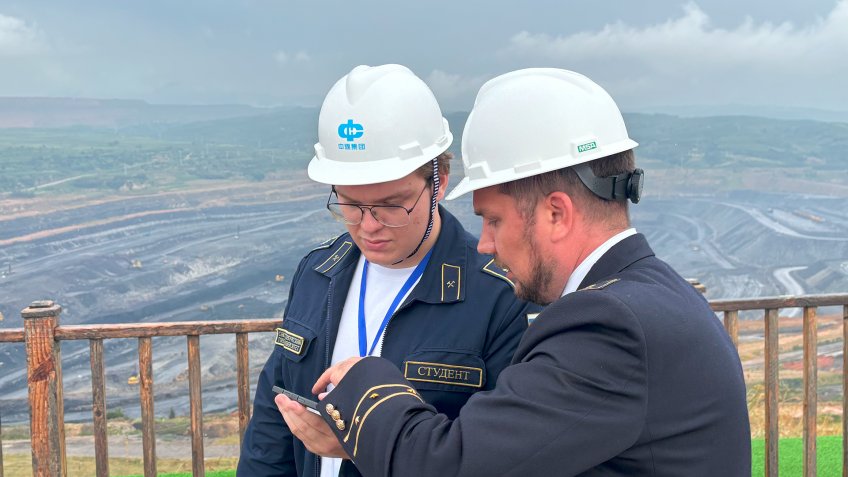
As part of their internship at Taiyuan University of Technology (TYUT), students and postgraduate students of Empress Catherine II Saint Petersburg Mining University visited Antaibao, one of China’s largest and most highly automated coal-mining operations, owned by China Coal.
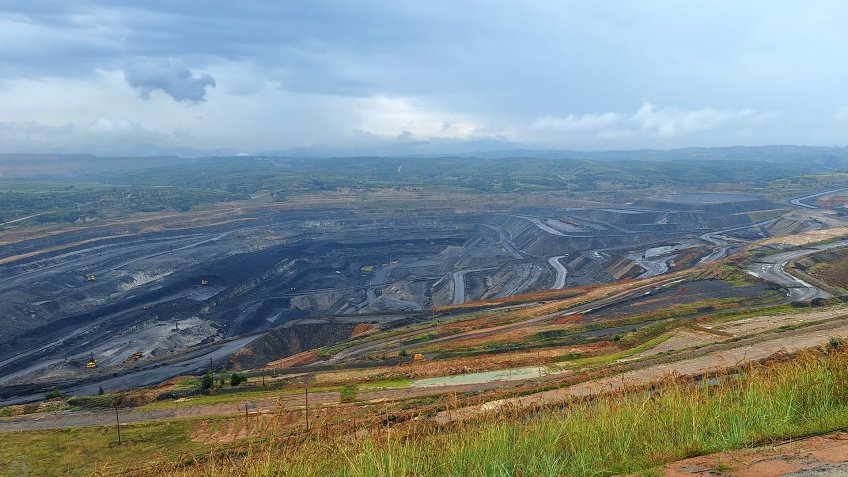
The company’s management team told the visitors about its history, the technologies used, and the organization of operations.
Construction began in 1982 on the initiative of Deng Xiaoping, the “father of China’s reforms,” as a flagship project of the country’s reform and opening-up policy. It was here that modern industrial methods of open-pit coal mining were first introduced in China, with rail haulage replaced by haul trucks.
The current production capacity is 20 million tonnes of raw material per year. Blasting operations are carried out once a week. The mine uses ultra-heavy equipment, including P&H 4100PC and WK-35 electric mining shovels with bucket capacities of 55 and 35 cubic metres, respectively, as well as Komatsu haul trucks with payload capacities of up to 290–300 tonnes.
Mining conditions are favourable: the coal seam reaches 33 metres in thickness, with an average stripping ratio of 0.5, meaning that the volume of overburden to be moved per tonne of coal is minimal. The coal is thermal coal, with a calorific value of 4,500–5,000 kcal/kg.
The delegation from Saint Petersburg assessed the scale and operations of the open-pit mine from an observation platform, descended to the 1,150-metre level of the pit to see the shovels and haul trucks, inspected the coal-seam drilling area, and viewed the enclosed conveyor galleries used for material transportation.
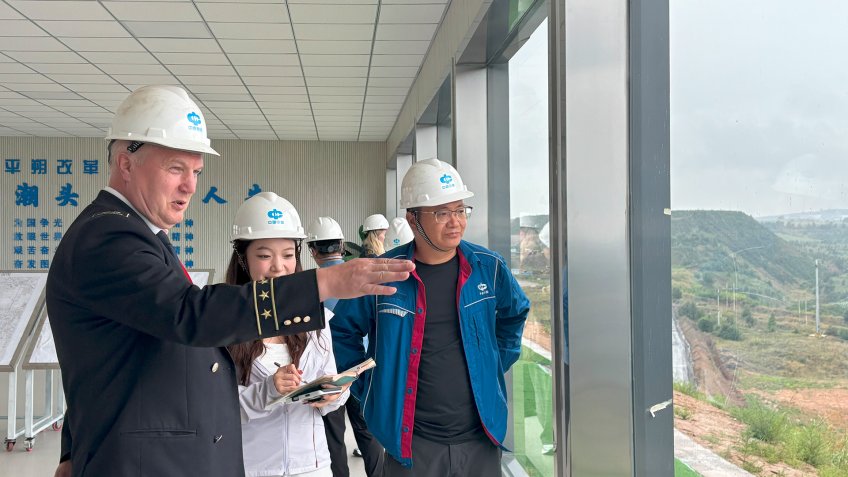
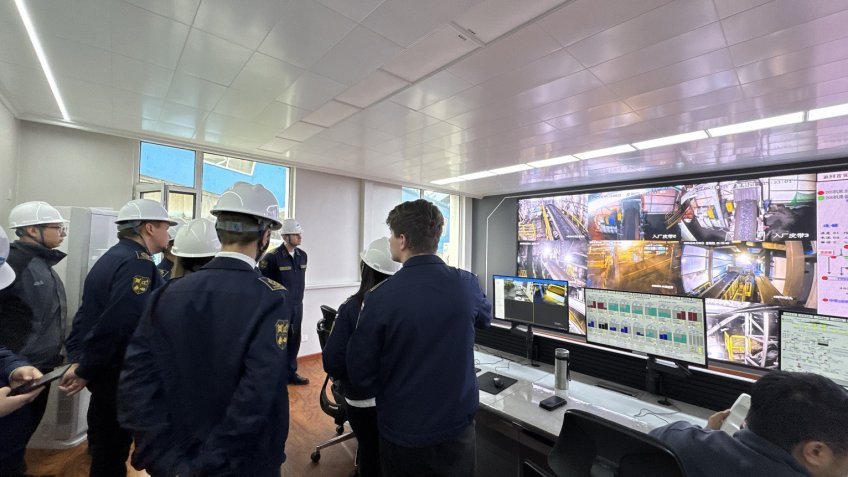
«Today’s visit was the most interesting, important, and long-awaited part of the two-week internship. It provided a clear picture of the actual production cycle — from drilling and blasting to the shipment of extracted material. I had the opportunity to see what equipment is used and how the technological processes are carried out. The scale was truly impressive. In the future, this experience will help me visualize and understand what open-pit mines look like when we study open-pit mining operations in our classes. Moreover, my knowledge will now include international experience», - shared first-year student Nikita Zabolotsky, who specializes in Mine Surveying.
The visit of the Saint Petersburg students to the coal mine is particularly noteworthy in light of the specific approach to practical training at universities in China.
In the PRC, students do not work at mines or open-pit operations during their studies to acquire practical skills. Only after receiving their degrees and taking up employment does the host enterprise provide them with an additional six months of practical training. Only after this six-month period do they begin working in a specific position.
«The open-pit mine is a classic example of a large-scale, highly mechanized mining enterprise. In July, I completed my practical training at the domestic open-pit operations of LSR.Basic. Although comparing Antaibao with the Kuznechnoye granite quarry and the 33 km sand quarry that I visited is not entirely accurate, it was nevertheless useful to identify differences and similarities in several aspects — the equipment used, mining technologies, production process management systems, and land reclamation. For example, at our construction-material quarries, reclamation — flooding the quarry pit — takes place only after the reserves have been fully extracted. At Antaibao, the principle of concurrent reclamation has been followed since the 1980s: restoration proceeds in parallel with the advancement of the mining front, which helps reduce the overall financial burden and mitigate environmental risks», - noted Nikita Khudoyarov, a student specializing in Industrial Management.
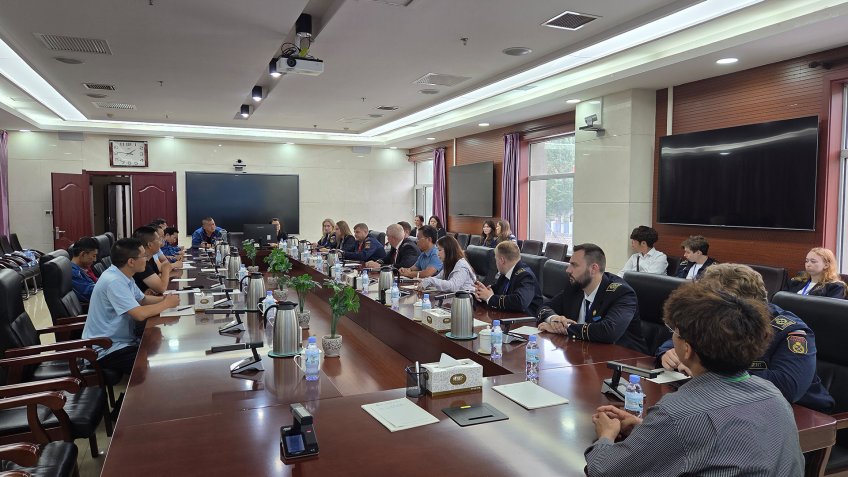
During the visit, Mining University representatives held a conference with the mine’s management, addressing issues related to industrial safety, the introduction of modern technologies, environmental monitoring, and the quality of personnel training.
Postgraduate student Alina Evsyukova, specializing in Geotechnology and Mining Machinery:
«The enterprise operates around the clock in three eight-hour shifts, with a workforce of only about 700 people. China’s experience demonstrates that even with such a workforce, an open-pit mine with an annual production capacity of 10–20 million tonnes can achieve high productivity. This has required a revision of approaches to engineering education, with an emphasis on multidisciplinary training. Specialists are proficient in mining, digital systems, and logistics. Companies actively use corporate training centres and simulation trainers for drivers and excavator operators, which significantly reduces accident rates. It would be advisable to replicate similar practices at Russian universities and mining engineering training centres, although today they have been implemented most comprehensively at the Mining University».
The West has already acknowledged that completely abandoning coal is impossible: extending the operating life of coal-fired capacity serves economic interests. At the very least, ensuring a reliable power supply currently cannot be achieved with power plants relying solely on alternative energy sources. The solution lies in increasing the environmental responsibility of modern production and developing a comprehensive understanding of sustainable development in the mining industry among future specialists.
«Antaibao clearly demonstrates the current level of development of open-pit mining. Chinese companies strive to minimize the environmental impact of mining operations. At China Coal’s enterprise, a combined waste-dumping method is used, with part of the overburden placed in the mined-out space, thereby reducing the area of land involved in mining. In addition, technology is used to minimize coal dust emissions: there are no open coal stockpiles, mobile dust suppression is carried out at the working face, and all conveyor lines are enclosed. This is a requirement of the PRC government. Global experience in open-pit coal mining demonstrates the potential of advanced mining methods», - noted Yegor Loginov, Associate Professor at the Department of Open-Pit Mining.