
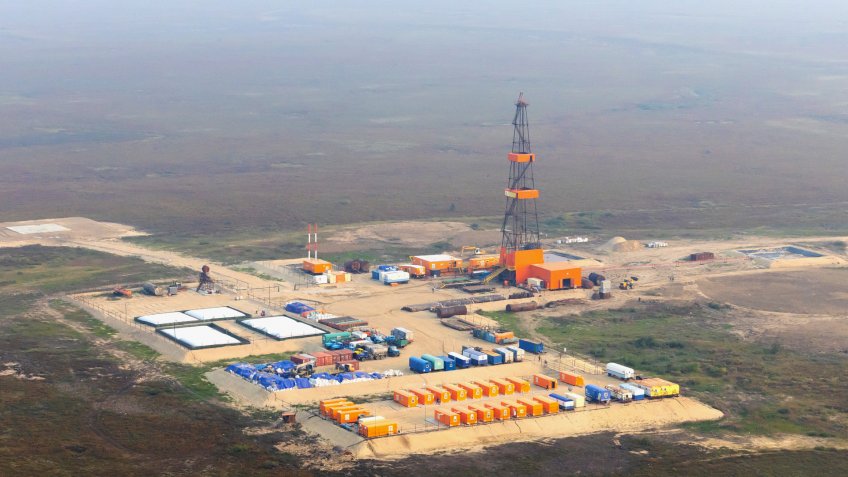
Empress Catherine II Saint Petersburg Mining University is conducting a comprehensive research programme to study the deep structures of the Earth, including field research in the Komi Republic. In his scientific paper, “The Concept of the Modern Worldview on the Deep-Seated Genesis of Timan-Pechora Hydrocarbons,” Rector Vladimir Litvinenko outlined the main focus of the research: the study of tectonic processes and their consequences at different stages of lithosphere evolution, from hydrocarbon generation in source rocks to their migration, accumulation, and subsequent transformation of deposits. The paper is currently being prepared for publication (In Press status) in the Journal of Mining Institute.
The Mining University has already begun drilling two research wells. The researchers need to obtain core samples from below the Devonian deposits. This will provide valuable material for studying the structure of the Earth’s crust. The rock samples will be processed in the material analysis laboratories of the university’s National Research Centre for Deep Metageology.

Scientists at Empress Catherine II Saint Petersburg Mining University aim to obtain additional data on the deep structure of fold belts and conduct a set of specialized studies into the zonal manifestation of magmatic activity and the occurrence of oil and gas fields. In addition, they will investigate patterns in the distribution of hydrocarbon deposits and their relationship with specific palaeotectonic and geodynamic settings, as well as assess the hydrocarbon potential of the Cis-Ural Foredeep from the perspective of lithospheric tectonics.

The author of the scientific paper notes that the geodynamic results obtained from drilling the Timan-Pechora reference well in the second half of the twentieth century provide clear grounds for further studying the genesis of petroleum at great depths and the formation of multilevel hydrocarbon deposits using modern technologies.

The Timan-Pechora oil and gas province is located within the marginal foredeep zone of the northeastern part of the Russian Platform. Vladimir Litvinenko notes that the research is being conducted in an area where the Earth’s crust contains channels for the migration of groundwater, fluids, and various elements, resulting in the formation of deposits of different mineral resources. The paper describes the tectonic processes that influence the formation of migration pathways for hydrocarbons from the Earth’s depths and the “natural traps” where they can accumulate.
The Rector of the Mining University argues that hydrocarbons are generated at great depths under conditions of elevated pressure and temperature. Gigantic endogenous [deep-seated] energy creates thermodynamic, geochemical, and tectonic conditions in the lithosphere for the synthesis of multicomponent mineral deposits from individual chemical elements, followed by the attainment of a state of thermodynamic equilibrium. Within the lithosphere, different geological epochs leave traces of processes that give way to new local and global tectonic phenomena. The final formation of petroleum from multicomponent elements takes place in the upper part of the lithosphere.

The site selected by Empress Catherine II Saint Petersburg Mining University for ultra-deep research drilling is characterized by favourable conditions for the formation of deep-seated oil accumulations, both in structural and tectonic terms (the presence of folds or faults) and in lithological and facies terms (the presence of rocks that enable fluid filtration).