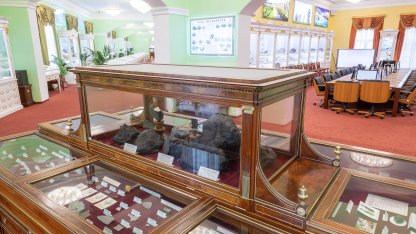
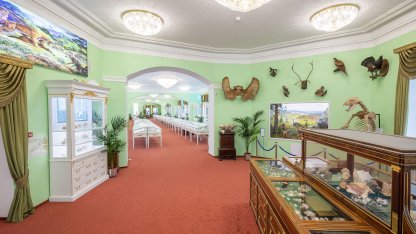
The Hall is home to samples of the most significant metallic, non-metallic and hydrocarbon fields both in Russia and abroad, and models of the Berezovsky gold deposit and the Ridder-Sokolny polymetallic deposit.
The expositions of the Hall are devoted to the internal structure of Earth and methods of its study, endogenous geological processes occurring in the depths, and exogenous ones which form the surface relief.
The regional and monographic collections of fossil flora and fauna are arranged in chronological sequence according to the geological period. The specimens showcase the geological record of our planet from the Neogene to the most ancient Archean deposits.
The exposition dedicated to the Quaternary - the shortest geological period in the history of Earth, in which modern humans evolved - opens up the Mining Museum’s geological collection.
The collection of models can be traced back to 1773 when the Mining School was opened, with the primary purpose being to help Russian students in handling mining and engineering equipment.
The Hall exhibits items of decorative and applied art and jewelry made of malachite, lapis lazuli, rhodonite, charoite, labradorite, gypsum, marble, agates, rock crystal, amethyst, as well as jade, agalmatolite, jet and other ornamental stones.
 Форпост Северо-Запад