
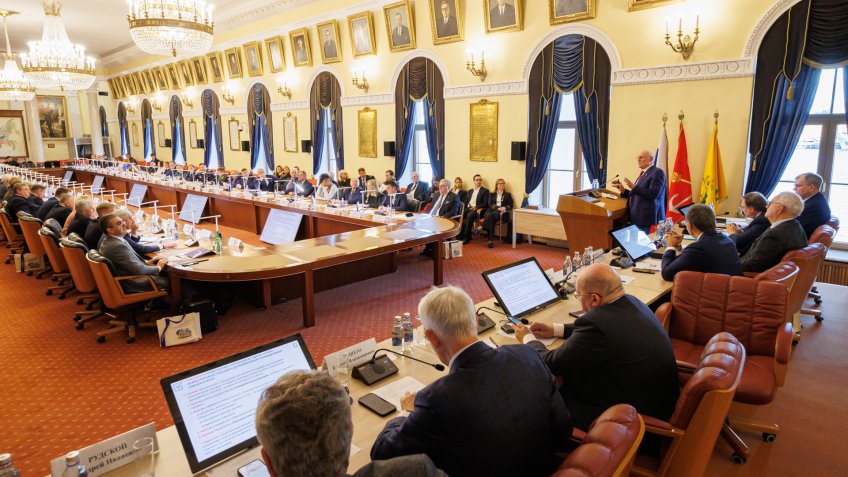
A meeting was held within the walls of Russia’s oldest technical university to discuss the interim results and future prospects of the pilot project aimed at improving the higher education system, carried out in accordance with Presidential Decree of the Russian Federation No. 343 of May 12, 2023.
The first stage of the experiment has been completed: the key parameters of a sovereign domestic university system, which has moved away from the Bologna standards, have been established, making it possible to proceed with its large-scale implementation. At the core lies a holistic educational model developed and, for the past two years, successfully implemented within the pilot project by Empress Catherine II Saint Petersburg Mining University.
Its concept envisions the creation of a fundamental educational core with a unified list of basic disciplines within an expanded group of specializations and fields of study. At Empress Catherine II Saint Petersburg Mining University, this stage corresponds to the 1st and 2nd years of study. Upon completion of this core period, students are able to adjust their choice of specialization.

The university has transitioned to a six-year program for the training of mining engineers. When scaling the model to other areas, the length of study may vary depending on the complexity of the programs in each particular specialization. In addition to the extended duration of training for mining engineers, the model provides for the acquisition of at least eight additional competencies and two working professions. A portion of graduates (3–8%), provided they undergo appropriate supplementary training, may also qualify for a second diploma as a “research engineer” after successfully defending their work before a specialized academic council.

An important component of the model has been the strengthening of students’ practical training and the close alignment of curricula with the needs of the labor market. The key industrial partners of the Mining University have acquired the status of academic partners. The new format of cooperation provides for deeper involvement of companies in the educational process through continuous joint work with the specialized Department of Practical Skills and Experience.

Enterprises and the university jointly assess the level of professional skills acquired by students and organize the work of a qualification commission to determine residual knowledge. Representatives of the academic partner also participate in the defense of graduation projects. For company employees working with interns, a new status has been introduced — “Industrial Mentor of Students.

According to the Minister of Science and Higher Education of the Russian Federation, Valery Falkov, the choice of venue for the meeting was no coincidence:
«Empress Catherine II Saint Petersburg Mining University has, in fact, become the leader of the pilot project, as it was the only one among the six participants that, as early as 2023, began admitting all first-year students under the new model. The Mining University has gone further than others in shaping a new system of higher engineering education. By drawing on its experience, we are transforming a wide range of areas of engineering education and working on improving postgraduate training.
The meeting is being held at the Mining University also so that rectors of other universities in the project, as well as leaders of institutions wishing to join it, can see how the material and technical base is organized here, what practices are being used, and interact with faculty members and organizers of the educational process».
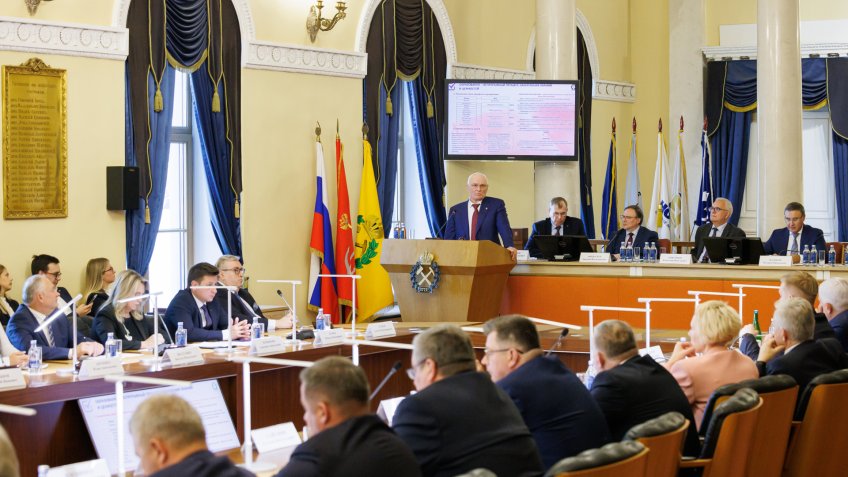
The Rector of Empress Catherine II Saint Petersburg Mining University, Vladimir Litvinenko, stated that more than 7,000 students are already studying under the new program. This year, compared to the previous one, the number of applications submitted by prospective students increased approximately three and a half times. This, he emphasized, is a strong indicator of the growing demand for high-quality engineering education.
«The results of the first years of the experiment inspire me to continue along the chosen path. It will lead to the creation in Russia of an engineering corps that meets the needs of the modern economy. Without it, the sovereignization of the country is impossible» – said Vladimir Litvinenko.
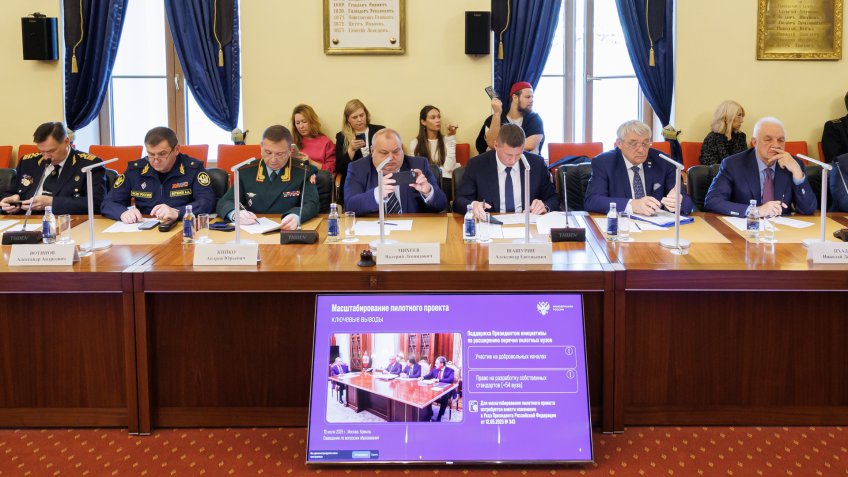
In his report at the meeting, he emphasized the importance of creating a unified regulatory and methodological framework for higher education:
«A country moving in different directions in education is headed for a dead end. Of course, sectoral specifics must be taken into account, but the foundation must be unified. It is also important to understand that improving the university system cannot be done in isolation from schools. There must be an unbroken line linking school subjects with university disciplines. We need to restore useful experience from past years to university programs while preserving and further developing effective modern practices.
At the outcome, the country must receive a specialist — in our case, a mining engineer — who possesses high professional competence, communication skills, a well-developed ability for creative problem-solving in their field, awareness, and motivation for professional growth. In addition, they must have knowledge of economics, methods of ensuring environmental safety in production, an understanding of trends in science and technology in their field, and the ability to apply them in practice. Most importantly, they must possess a holistic worldview within their specialization».

The National Research Tomsk State University, as a classical university, entered the pilot project with a wide range of programs, including natural sciences, social sciences and humanities, as well as engineering. According to its rector, Eduard Galazhinsky, such breadth creates both advantages and challenges due to the fundamentally different nature of the programs. Like Empress Catherine II Saint Petersburg Mining University, TSU places significant emphasis within the project on strengthening students’ practical training. Systematic work in this direction has required an increase in resource allocation — from 12% to 40% depending on the program — which, as the rector of TSU noted, is both a task and a challenge.
In addition, he highlighted the emergence of new professional positions not yet reflected in the official qualification directory of occupations. Here too, systemic solutions are required.

At the Immanuel Kant Baltic Federal University, out of 3,103 first-year students admitted in 2025, 925 were enrolled in pilot programs.
«We paid great attention to motivating employers. They are directly involved in the educational process — in fact, they are the ones designing the profile of the graduate. Together with representatives of enterprises, we examine and analyze the pilot educational programs under a magnifying glass» – said Acting Rector of the university, Maxim Demin.
The Moscow Aviation Institute joined the pilot project in two stages. In 2023, 40% of the student intake was directed into pilot programs, primarily covering the university’s core engineering specialties. By 2024, the transition was completed, and all students were enrolled under the new format.
«We have moved to a modular structure of educational programs in order to build individual educational trajectories. We believe that modules should allow students to try themselves in different areas of activity to understand where they can be most effective» – said Rector of MAI, Mikhail Pogosyan.
The Rector of the Moscow State Pedagogical University, Alexey Lubkov, supported the idea of creating a core of fundamental higher education and noted that, within the pilot project, MSPU pays significant attention to developing the training of multidisciplinary specialists, which is especially relevant for small rural schools. For example, teachers of physics and chemistry.

The National University of Science and Technology "MISiS," within the framework of the pilot project, is working in particular on the development of a continuous education system. The university strives to immerse students in project-based activities starting from their first year of study and is actively developing a system of mentorship.
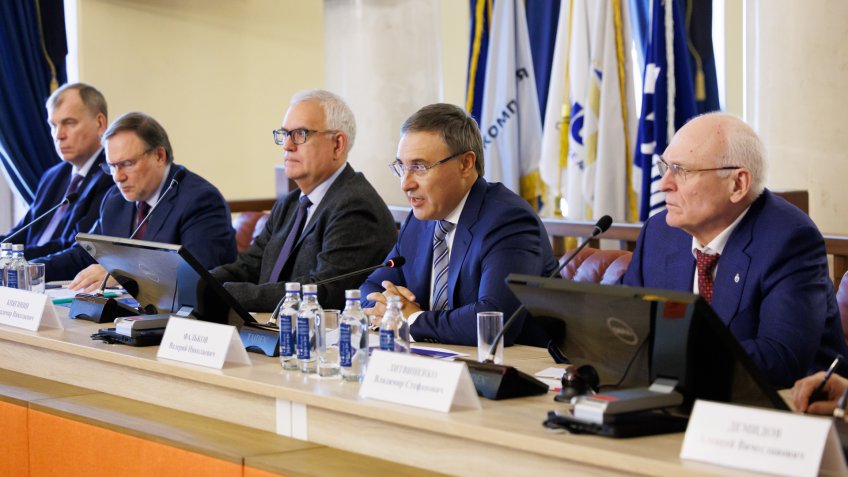
Summarizing the participants’ reports, Valery Falkov noted that the experiment had made it possible to form a sufficiently clear picture to move forward — toward scaling. At the same time, the transition to the new educational model must be gradual. The Ministry intends to devote the second half of 2025 and the year 2026 to promoting the project’s ideas within the university community and to engaging new participants.
Vladimir Litvinenko proposed scaling the project through the creation of sectoral university clusters, with a leading institution at their center, responsible for communication and the development of a unified methodology. Many Russian universities have already expressed interest in joining these clusters — for example, Transbaikal State University, Grozny State Oil Technical University named after Academician Millionshchikov, and Donbass State Technical University.
For the organization of further work, in Litvinenko’s view, the structure of the Ministry of Science and Higher Education of the Russian Federation should include a dedicated project supervisor at the level of deputy minister.
The Rector of Empress Catherine II Saint Petersburg Mining University also identified networked technological test sites as an important infrastructural element of inter-university cooperation within the cluster. The university is actively developing such sites, in particular, the Sablino Educational and Research Test Site in Leningrad Oblast and another in the Bakhchisarai District of the Republic of Crimea. The university has invested significant extrabudgetary funds in their creation and is ready to open the doors of its test sites to partner universities.
