
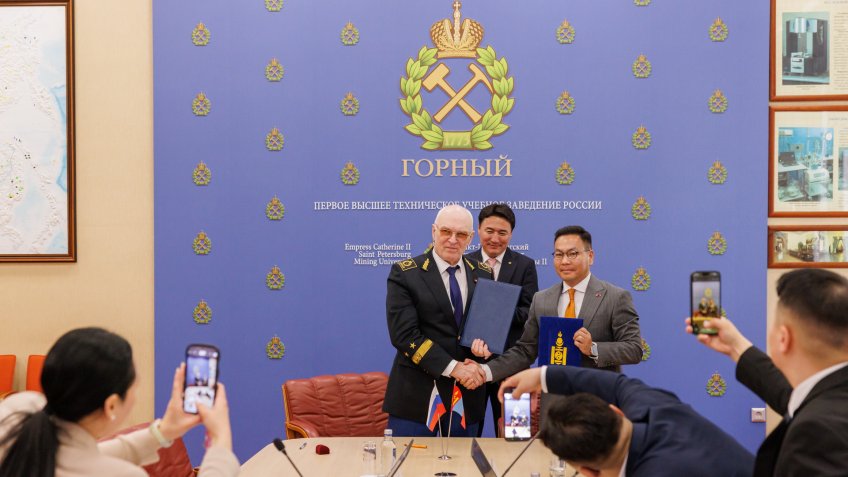
A Mongolian delegation led by the Minister of Industry and Mineral Resources, Gongor Damdinyam, visited the Empress Catherine II Saint Petersburg Mining University. The delegation included the leadership of the Russian representative office of the state-owned company "Erdenes Mongol" and two of its subsidiaries: "Erdenes Gaz," which is responsible for the construction of the "Power of Siberia" gas pipeline through the territory of Mongolia, and "Erdenes UTP" (Industrial and Technological Parks of the Mining Industry).

The mining industry constitutes the foundation of Mongolia's economy, accounting for 95% of its total exports. The primary export commodities are copper ore and coking coal. Since 2008, the sector has been controlled by the state through the diversified holding company "Erdenes Mongol." Currently, the government is pursuing a course toward accelerated industrialization and the development of deep processing for minerals. Concurrently, geological exploration is being intensified, including joint initiatives with Russian companies in border territories. According to preliminary estimates, these efforts could uncover new deposits containing significant reserves of gold, silver, copper, tungsten, coking coal, lead, and rare-earth metals.
Even during the Soviet era, Saint Petersburg Mining University trained a substantial number of highly qualified engineers and executives for Mongolia. The country's first president, Punsalmaagiin Ochirbat, was among its prominent alumni. He twice presented the university with Mongolia's highest state award, the Order of the Polar Star. During the meeting with the Mongolian guests, Vladimir Litvinenko, Rector of the Mining University, shared that during the period of structural modernization of the Mongolian mining industry, he had discussed with President Ochirbat the advantages of the deep processing of mineral raw materials compared to the sale of concentrate.
«The Mining University is the only Russian higher educational institution that has preserved the finest traditions of the domestic engineering school. We train students from many countries of the Global South, including Mongolian scholars, and we are prepared for closer educational cooperation. Your country will also find the university's scientific research potential highly beneficial. Joint work is essential, particularly regarding the development of 'Erdenes Gaz': it is crucial not simply to transit gas through your territory, but to involve it in domestic processing—to manufacture final products in gas chemistry, for example. Such an opportunity must not be missed», – stated Vladimir Litvinenko.
The meeting with the Rector took place following a guided tour for the Mongolian delegation through the classrooms, scientific laboratories, and the Mining Museum of the Mining University. During the meeting, Gongor Damdinyam joked that he felt a sudden impulse to "take the Mining University back home to Mongolia".


«We acutely require high-tech extraction and processing industrial sectors. The expansion of deep processing for raw material resources has become a priority of state policy. Consequently, this drives a growing demand for highly qualified specialists. We request an increase in the enrollment quotas for our students. There will be many candidates eager to study engineering specialties in St. Petersburg. In recent years, the youth of Mongolia have shown an active interest in professions associated with the resource sector», – stated Gongor Damdinyam.

The visit concluded with the signing of a memorandum of cooperation between Saint Petersburg Mining University and "Erdenes UTP." This entity serves as the management company for a cluster of industrial and technological parks across six locations in Mongolia, encompassing projects dedicated to the deep processing of copper concentrate, steel production, coke chemistry, coal chemistry, and fluorspar processing.
The memorandum provides for collaboration in the targeted training of engineering personnel at the Mining University, particularly within the specialties of mining engineering, mineral processing, metallurgy, chemical engineering of raw material processing, automation of technological processes, and industrial ecology. It is anticipated that at least 50 students will be admitted for training annually. Beyond foundational higher education, enrollment in specialized higher education programs is envisaged, alongside supplementary professional education for the company's personnel.
The cooperation program also includes scientific and technical projects, as well as the execution of technological audits and engineering support by the university's experts along the priority operational directions of "Erdenes UTP."
An agreement was also reached regarding the organization of industrial and pre-graduation field internships for Mining University students at facilities in Mongolia, the execution of cross-internships, joint scientific and practical conferences, seminars, and "summer schools".
A detailed roadmap of cooperation for the next 2–3 years will be prepared by the deadline of August 1, 2026.
During the visit, the Minister held a meeting with his compatriots currently studying at Saint Petersburg Mining University. To date, there are 17 Mongolian students enrolled at the university.
