

All 11 graduate students of St. Petersburg Mining University, who had been working on their research projects in Germany for six months, returned safely to the city on the Neva. Has the special military operation of the Russian Army in Ukraine made adjustments to the internship of young scientists? Have they ever encountered cases of Russophobia? Or even starve because the opportunity to receive a bank transfer was significantly limited? Outpost addressed these and other questions to Valeria Starshoy, one of the participants of the joint Russian-German program "Natural Resources – Energy – Sustainability". Last year, during the competitive selection, she earned the right to receive a PhD at the Dresden Technical University, where she went in February.
- Valeria, three weeks after you arrived in Germany, a special military operation of our army in Ukraine began. Wasn't it scary to stay in a strange and, as it turned out, unfriendly country for us?
- If we didn't watch TV and didn't go on the Internet, we would probably never have known that anything had changed in the relationship between our states. Neither in the dormitory, nor at the university, nor on the street, nor in the stores, did anyone ever make any unfriendly remarks, much less take any actions toward us. In other words, ordinary Germans certainly do not suffer from any Russophobia.
But for the first three or four days, of course, we were a little uncomfortable. First of all, because of uncertainty. While waiting for the official decision, we, in fact, sat on our suitcases. Because, on the one hand, both our and the Dresden university told us that all the agreements remained in force. But on the other hand, on the website of the German Academic Exchange Service DAAD, which was the organizer of the internship on a parity basis with St. Petersburg Mining University, there was an announcement about the termination of the program.
However, it was soon explained that this only applied to Germans who had studied in Russia, and had nothing to do with us. The administration of the Technical University of Dresden sent an official letter stating that all students and graduate students, no matter what country they were from, could expect the same treatment and any possible assistance. Similar assurances followed from the management of the dormitory. So the pause was not long at all, literally on the fourth day we have already begun the planned work.

Of course, no one wanted to go back to Russia early. After all, we had undergone a very serious competitive selection process in order to take part in this program. Each of us was well aware that the double doctorate was a very great competitive advantage, and it would probably be a mistake to give it up.
- Your stay in Germany was paid on a parity basis by the International Competence Centre in Mining Education under the auspices of UNESCO and the German Academic Exchange Service DAAD. Were there any difficulties in obtaining funds due to the fact that Russian banks were disconnected from the international payment system?
- Fortunately, there were no problems with the scholarship, as our university transferred its part of the funds to the German side in advance, in a single tranche. And we immediately after our arrival in Germany arranged German bank cards, where DAAD transferred money every month. Unfortunately, we could not use our Russian cards because they were blocked in Germany, which, of course, created certain difficulties.
- Was the entire research program completed? And have you been provided with all of the laboratory equipment necessary for your research?
- As promised by the management of the Technical University of Dresden, we were treated exactly the same as young scientists from other countries. Personally, I worked only in one laboratory, and its level of equipment was quite sufficient to fulfill all the initial tasks. But the value of this internship was not only in the opportunity to conduct one or another laboratory study under the guidance of a German professor.

The point is that my research interests include reducing the negative environmental impact of oil production facilities that are remote from centralized networks. Usually, diesel generators are used for their power supply, because it is too expensive to pull power lines there. But, as we are all well aware, they emit significant amounts of greenhouse gases into the atmosphere, including CO2.
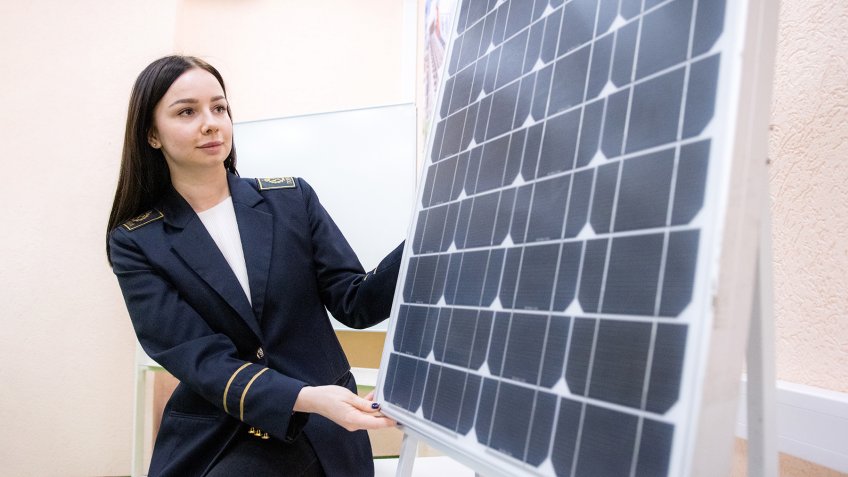
So, in Dresden, during the experimental part of the internship, we designed a control system for such a complex. It consisted of solar panels, fuel cells, lithium-ion batteries, and electrolyzers that generate hydrogen on sunny days, which should be used to generate electricity at night or on cloudy days. This allowed me to identify new patterns and obtain additional data for further computer modeling.
- As I recall, unlike some other graduate students who rented small private houses, you lived in a dormitory. How comfortable were the rooms there? And did you have any domestic conflicts with your neighbors?
- The rooms were quite comfortable, the kitchen was shared, one per floor. Initially we applied for studios, but as it turned out, only people who had been studying in Dresden for at least a year could occupy them. The neighbors were different, we did have a conflict with them once, but not at all because of the events in Ukraine, as you may think, but because of their untidiness. But, thank God, thanks to the intervention of the administration, everything was resolved in the most favorable way.


- As far as I understand, cooperation between Russian universities and the German Academic Exchange Service DAAD continues today, in spite of everything. Would you personally advise our students and postgraduate students to go to Europe to study now?
- A six-month internship abroad is, of course, a great opportunity to immerse yourself in a new scientific and educational environment and gain additional competencies. And not only in the profile of my research project. We, for example, picked up technical English, which allowed us to read foreign scientific literature in its original language and communicate more with colleagues from other countries. Today, when many joint projects have been frozen, this is especially important.
- When will you get your European degree?
- So far this question, as they say, has hung in the air. In June, I reported to the professors of the Department of Energy Storage at the Technical University of Dresden on the results of my research. The report itself and the answers to questions took about three hours, but in the end my work was positively evaluated. At the end of September the final presentation at the seminar on the results of the experiment is planned. However, at the moment there is no question of awarding the status of PhD because the German university took a wait-and-see attitude due to the situation in Ukraine.
But in any case even if I don't get an official document of European degree I will consider my internship in Germany as a very useful experience. Firstly, because it broadened my horizons in general, and secondly, because I was able to acquire useful contacts with foreign partners working on similar topics. For example, we have already reached agreements with our German colleagues that we will continue our cooperation in any case.