
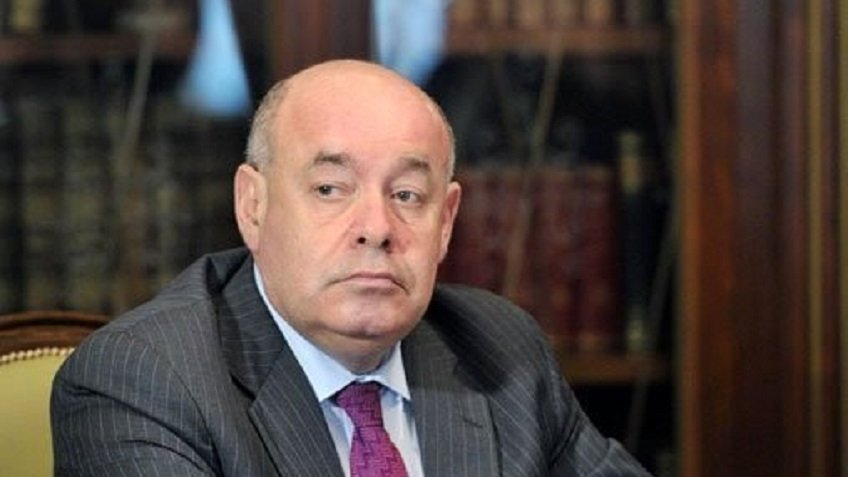
Mikhail Shvydkoy, a professor at Russia's oldest technical university, said that today the fate of our country for centuries to come is being decided.
Mikhail Shvydkoy: The cancellation of the St. Petersburg International Cultural Forum seems to me a perfectly reasonable step. And it is not because the organizers could not get consent from foreign partners to come. I am certain that its participants would have represented as many, if not more, countries than the St. Petersburg International Economic Forum held at the beginning of the summer of this year.
And it would still be possible to discuss the problems of international cooperation, including those with today's unfriendly West, focusing, however, on a variety of cultural projects which can be successfully implemented in the CIS, the Middle and Far East, other Asian, African and Latin American countries. Two enormous and truly undiscovered creative industries markets - China and India - are an undeniable opportunity for Russian culture.
But the current proposed circumstances, which have radically changed life not only in our country but throughout the world, require us to rethink the role of Russian culture and cultural figures in the modern space of being. It is impossible to pretend that our life has not changed and that 2022 is cardinally indistinguishable from what has been happening to us in previous decades. It is no longer possible to live by inertia, trying to evade contemporary reality. We need to ask questions, addressed primarily to ourselves, that are hardly worth discussing on international platforms. If only because there are no unequivocal answers. All the more so because any cultural forum will be perceived as an inappropriate sprawling celebration today.
The present circumstances require us to rethink the role of the native culture.
Today it is more important for us to define the internal agenda in culture, to understand the new challenges and our reaction to them. It is more important for us to comprehend the collective and individual reflection. If only because we all understand to a greater or lesser degree that Russian life is undergoing an essentially historical turn. And you can disavow this "we" as much as you like, just as in the old Soviet times a "conservative" type of literary critic loudly proclaimed that he did not want to be in the same "we" as Yevtushenko. Nevertheless, anyone who cares about the fate of Russia gets into this "we" regardless of his subjective desires.
It is important to understand that the development of national culture (or national cultures, since Russia is a state with many ethnic groups) is associated with large lines of development, with a diversity of not only socio-economic, but also natural and biological processes. Even in periods of revolutionary explosions and the destruction of traditional ways of life, it retains the root system of national life, which, in fact, makes one nation different from another. That is why Russian culture retained its genotype during the centuries of Horde rule, during the reign of Peter the Great, after the October coup of 1917, and after the self-dissolution of the USSR. It is clear that, as in the natural world, it was not without mutations - in the spiritual and material spheres.
And quite serious ones at that. They were connected, among other things, to the catastrophic loss of life in the twentieth century - in the Russian Empire and in the Soviet Union. The new Russia left almost 26 million people who consider themselves bearers of Russian culture outside their country. Much more than in the revolutionary years. All this does not pass without a trace, as any dismemberment of the ethnic group. And these processes have a much more significant impact on culture than any desiccating ideological pressure. This is why Alexander Solzhenitsyn's idea of the preservation of the people is linked to the preservation of culture, which in turn determines the identity of the people itself, its destiny in historical existence. Any political and economic reverses do not cancel the fundamental values, which are associated not only with history, but also with geography. Russia's Christian choice was determined, among other things, by its integration into the European space.
Crimea, where the symbolic baptism of Russia took place, was part of the ancient oikumene, the cradle of European culture, which retained its significance for all subsequent Russian life. Moscow had every reason to claim the role of the third Rome-not only religiously, but also culturally. Before the harsh reforms of Peter the Great, the organic development of Muscovy was directed toward cultural synthesis, in which the European tradition played a major role. Russia as perceived by Asia was always a European state, no matter how it was perceived west of the Danube or the Oder. All of this must be realized before we can proceed to reflect on the fate of culture and art in the most difficult current moment in history that our country and its multinational people are experiencing.
Today the fate of centuries is being decided, so it is impossible for Russia to be defeated militarily and politically
It is important to understand that Russia's fate for decades, if not centuries, is decided today. That is why it is impossible for Russia to suffer a military-political defeat. The country is balancing on a fine line between familiar everyday concerns, seeking to preserve the relative material and spiritual comfort of its citizens, and the need to strain all its forces to ensure security in its new sense of the word. This complex internal state of society cannot help but be reflected in contemporary artistic practices. And as much as we would like an immediate creative response to everything that is happening, it takes time to make sense of all that is happening to us as we live the life of the country.