
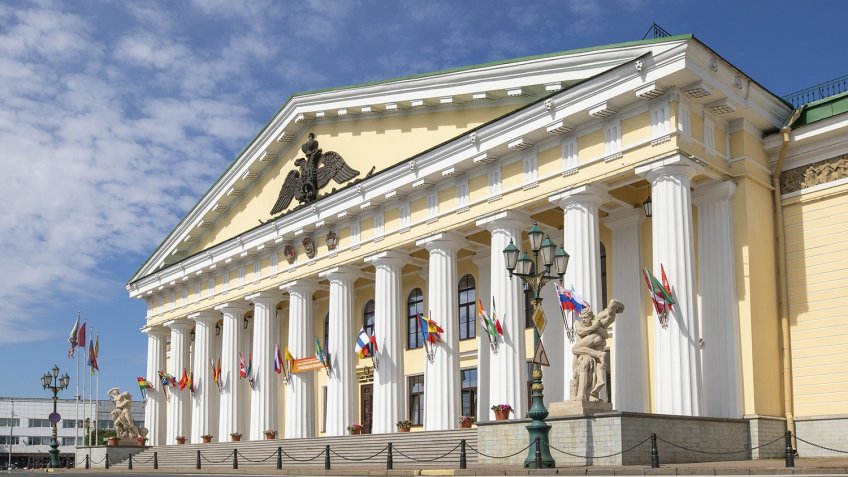
The rector of St. Petersburg Mining University Vladimir Litvinenko presented a draft strategy to radically improve the quality of training and use of specialists with higher technical education. This document has already been sent to the executive and legislative authorities, to the heads of the regions where energy, mining and petrochemical companies are present, to specialized public organizations, as well as to the heads of universities that are part of the Nedra consortium.
The main impetus to launch and implement this project was the proposal of President Vladimir Putin to return to the traditional system of higher education in order to reduce the shortage of engineering personnel. One of its undoubted reasons was the oversupply of 4-year educational programs. It is simply impossible to train competent young specialists in a number of fields within this period of time, they do not have time to acquire all the necessary knowledge and skills. Particularly little time is allocated at the bachelor's level for practical training.
The aim of Vladimir Litvinenko's initiative is to find the best way for the development of the national institution of higher education by exchanging opinions and forming the final concept on the basis of the best offers. All interested persons can express their ideas, please send your recommendations to the e-mail address: nedra@spmi.ru.
Forpost publishes the text of the strategy in full:
STRATEGY OF METHODOLOGICAL SUPPORT
TO RADICALLY IMPROVE THE QUALITY OF TRAINING AND
EMPLOYMENT OF STUDENTS WITH HIGH TECHNICAL EDUCATION
1. Restructuring of higher engineering education should be considered as one of the urgent, most important tasks of accelerating socio-economic development of the country and modern personnel policy.
2. The university is called to have a long-term, ever-increasing impact on the accelerated movement of society forward, dynamic transformation of the economy, improvement of social relations, radical restructuring of all aspects of its life. It has a special role in the development of humanization of society, people's spiritual culture, and activization of the human factor. Proceeding from this it is necessary to reach a new level of quality of training of specialists in close connection with the radical improvement of their use, to enrich the ideological-theoretical, humanitarian content of higher education, to strengthen its connection with the social practice.
3. To ensure the training of personnel, combining deep professional competence and ideological conviction, high culture, civic engagement, brought up in the spirit of morality and patriotism. We will develop within specialists an ability to constantly update and refresh their knowledge, modern economic thinking, scientific management skills, and the ability to proactively and responsibly solve problems of scientific and technical, social and cultural progress.
4. Transition to a wide profile training based on a combination of fundamental, general scientific, general professional knowledge and targeted practical training. Specialization of students' training with involvement of professional communities of the labor market in order to better reflect the interests of the national economy branches in the process of their education.
5. To ensure constant revision (update) of nomenclature of specialties according to needs of economy branches and main tendencies of development of science and technology, by envisaging the opening of new specialties and specializations, as well as closing of the outdated ones.
6. To differentiate the content and terms of specialists with higher education depending on the nature of their future professional activity - design, technological, technical, constructive, operational, managerial, research and other. Strengthen the interdisciplinary links of the two disciplines under study. To provide a continuous, throughout the whole period of study, economic education, as well as legal and ecological training of students.
7. Adaptation of the graduate to the needs of the market is the transition to the training of a specialist with higher education (5-6 years of training) with the defense of the diploma project and the qualification "Engineer". Upon request, at the end of the 4th year of training (on the basis of general education, general engineering disciplines and disciplines on specialty (direction) of training) after preparation and defense of qualification work the international qualification "Bachelor" can be assigned. In this case a unified educational program on the volume and content of general educational, general engineering disciplines and specialty (direction) of training is used. Subjects of specialization are included in the 5-6th year of training.
8. Theoretical knowledge to consolidate: skills in training laboratories, at the testing grounds (up to 10% of the curriculum); experience gained at the production sites, and additional professional competences - during the whole period of training.
9. Fundamental training of students in the direction of "Master's degree" provides teaching special disciplines at the level of the highest achievements of modern science. Based on the mathematization of general-science and special disciplines, to achieve mastery of modern methods and means of scientific analysis.
10. "Master's degree" should remain in all directions as a special scientific and educational direction with a two-year training with the defense of the scientific final work - master's thesis and should be designed for no more than 10% of students. As a direction, allowing to take foreign citizens of the countries with multilevel system of training, with obtaining the qualification of "Master".
11. "Postgraduate studies" should provide training of scientific and pedagogical staff for universities and scientific support of economic development. For admission it is necessary to have a diploma "specialist of higher education" with a period of study of 5 or more years or a diploma "master", to have a reserve in scientific researches, to have organizational abilities, confirmed by the characteristic-recommendation issued by the university. The main task of the educational process is the mastery of pedagogical competence and scientific at the level that allows defending a thesis for the degree of candidate of sciences before the end of the "postgraduate" program.
12. Development of entrepreneurship in the scientific environment should be implemented through the implementation of scientific results - experimental industrial product obtained in the laboratories and pilot production conditions in the production with the participation of scientists and the university in the authorized capital.
13. To form in student teams an environment of active creative work to master the knowledge, the atmosphere of principled mutual demandingness. To fully develop and encourage students to compete in their studies, to nurture their determination, will, diligence, high responsibility for the results of their work.
14. To improve the system of formation of competitive environment of future specialists during the whole period of their training. To this end: - to improve the organization of examinations and credits as an important tool for objective and rigorous assessment of students' knowledge; - to decisively expel the students with irresponsible attitude towards studies already in their junior years; - to practice in higher educational institutions the attestation of full-time students at the end of general scientific and general professional disciplines. Based on its results, to carry out the distribution on specializations, to select the best students for in-depth training; - to raise the role of final evaluations of acquired knowledge in providing a demanding assessment of the quality of training specialists.
15. To increase the level of organization of the educational process - an important factor in educating students in the spirit of high discipline and concentration. To provide a rational class schedule, clear work of the departments, laboratories, libraries, all units, to create favorable conditions for the creative work of teachers and students. We shall resolutely enhance discipline and cherish every hour of teaching. To categorically forbid public events and distraction of students to work not related to the educational process during the instructional time.
16. Establish that at each stage of students' education, the practical training shall be conducted jointly with the basic enterprises, institutions and organizations, based on the principles of combining the studies with the production skills.
17. Create on the basis of the leading companies the educational-scientific-production complexes uniting the branches of the departments, joint research departments, experimental-industrial sites for practical skills of students, graduate students and increase the competence of teachers.
18. In order to practically consolidate the professional knowledge and skills of the graduates of higher educational institutions, to increase their responsibility for the results of their labor activity, to improve the use of specialists in the economic sector, to establish, that after three years of work a young specialist should pass a special attestation, which results in qualification "professional engineer" and gives him qualification certificate. To consider the results of attestation, conducted in enterprises and organizations with the participation of higher education institutions, as an important criterion of quality of training in higher education institutions in mastering professional competences and to take into account in evaluation of higher education institution activities.
19. Involve in the educational process the leading specialists from the industry, faculty of the highest qualification (doctors and candidates of science), with the passage of advanced training at least once every 3 years, with the constant improvement of teaching skills and pedagogical competence.