

In December, the Empress Catherine II Saint Petersburg Mining University will host the International Congress "Africa Seeks Solutions", during which the Russian-African Consortium of Technical Higher Education Institutions will be established and the relevant founding documents will be signed. The task of the new structure will be to develop and coordinate co-operation between the parties in the field of education and science, as well as to promote sustainable development of the extractive and processing sectors.
The composition of the participants is, without exaggeration, impressive. More than 100 heads of leading universities, representatives of executive and legislative authorities and big business from more than 25 African countries have already confirmed their arrival in the city on the Neva. Why are they interested in this forum? And what benefits does Russia expect from it? Forpost addressed this question to Vladimir Litvinenko, Rector of Mining University.
- Vladimir Stefanovich, the agreement of intent between the initiative group representing 9 African countries - Angola, Ghana, Zambia, Zimbabwe, Egypt, Namibia, Nigeria, Zambia, Zimbabwe, Mali and South Africa - and the International Centre of Excellence in Mining Education under the auspices of UNESCO, of which you are the Chairman of the Governing Board, was signed only three and a half months ago. It may seem like a very short period of time, but this time was enough for the initiative supported by Vladimir Putin during the Russia-Africa Economic and Humanitarian Forum to take real shape. Why is this important for your future partners who will come to us in December to participate in the congress?

Vladimir Litvinenko: The whole point is that the subsoil of this continent, like Russia, is rich in raw materials. Their potential is so great that, if it were fully unlocked, the citizens of many African countries would be 10 times richer than the Europeans. In reality, however, everything happens "exactly the opposite". Today, about half a billion people living south of the Sahara live in poverty, about 600 million do not have access to electricity, and 900 million do not have access to a normal cooker, i.e. they have to cook food in an oven or on a fire.
If you read Western sources, the main reasons for this state of affairs are mismanagement of land, misuse of funds, armed conflicts and so on. But such interpretations are an obvious substitution of concepts, designed to disguise the true reasons for what is happening. And they are that the vast majority of mineral deposits on the mainland are controlled by Western transnational corporations. Moreover, they work there not on the basis of licences to develop deposits, but on the basis of concession agreements.
In fact, this is a lease that allows foreigners to receive the main rent from the exploitation of subsoil, up to 80-85% of its total volume, without any responsibility for excessive damage to the environment and unwillingness to employ the local population. If you remember, 30 years ago, after the collapse of the Soviet Union, Russia faced a similar situation. Concession agreements with European and American companies deprived our federal budget of a significant part of its revenues, which was one of the reasons for an unprecedented drop in the living standards of the population. The situation changed only after the election of President Vladimir Putin, who put an end to this vicious practice and created the prerequisites for a sharp economic breakthrough.
- Но разве западные компании не создают новые рабочие места, не внедряют передовые технологии, не оказывают поддержку странам Африки, где ведут добычу?
Vladimir Litvinenko: Firstly, no one will ever give you any advanced technologies. And no one will give the local population the opportunity to work in leading engineering positions. They are always given to Western specialists, while indigenous people usually occupy much less prestigious and lucrative positions, the number of which is limited.
This was the case in Russia in the nineties, and it is also the case in Africa now, but of course it has become much more hypertrophied. For example, earlier this year, a lawsuit was filed in the Ontario Supreme Court on behalf of twenty Tanzanian citizens. They accused Canada's Barrick Gold of kidnapping, torturing and killing people who opposed its activities at the North Mara gold mine. And this is not an isolated case.
| Note: War on Want, an NGO that investigates the activities of British mining companies on the continent, says that representatives of the United Kingdom have been involved in at least several incidents involving the killing of local residents. In the most egregious case, activists point to the tragedy at the Marikana platinum mine, owned by London-based Lonmin. In 2012, 34 miners were killed and 78 injured while demanding living wages and decent living conditions. Although they were formally shot by police officers, Lonmin management was accused of escalating the violence. This is partly confirmed by the transcript of a meeting between South African security officials and top management of the company's local office. At the same time, the mines in South Africa, which it owns, contain about 42 million ounces of platinum, whose value is now estimated at almost $38 billion. The main profit from their development goes to the corporation's shareholders. |
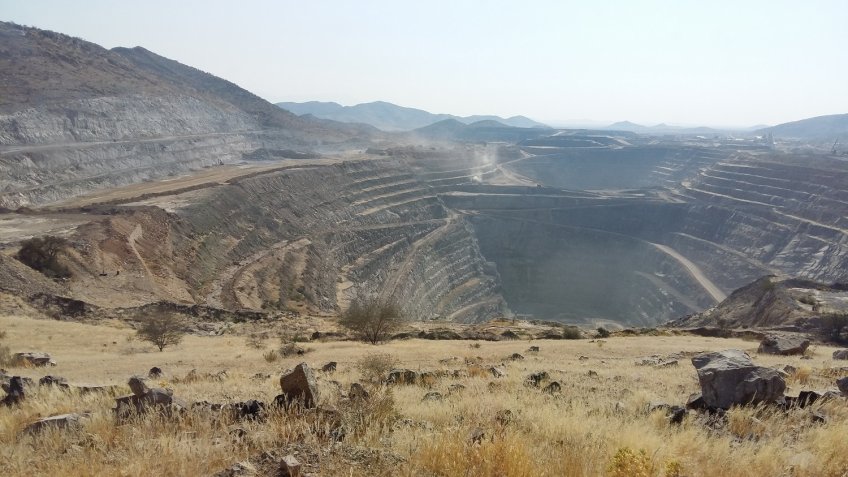
Vladimir Litvinenko: As for other incidents, they number not in the dozens or even hundreds, but thousands of episodes. We are talking about the forced eviction of people from houses in areas where mining is planned, numerous violations of the labour rights of ordinary employees, colossal damage to ecosystems, and tax evasion. This is a common practice, an accepted pattern of behaviour of Western companies in former colonies.
War on Want estimates that Britain's economic aid to the continent amounts to over $130 billion annually. It would seem a lot, but this is not a humanitarian action at all. It is primarily investment in its own facilities and loans to governments. The purpose of this strategy is to drag the states into debts, which will be used to repay the interest on which, practically, all the funds received from subsoil users for the lease of deposits under concession agreements will be spent. As a result, Africa itself gets practically nothing, but British companies withdraw nearly 200 billion dollars a year. That is, they make huge profits by controlling the most valuable resources of the continent - gold, platinum, diamonds, copper, oil and gas.
In fact, we are talking about a system of neo-colonialism. After all, the countries of the global north regard Africa exclusively as a source of raw materials, which can either be sold or involved in deep processing and receive additional revenue through the creation of surplus value. This is a typical policy of the metropolis, which a priori does not assume a fair distribution of income, but is based on the fact that the colonies will be sufficiently rewarded in the form of "glass beads".

- Is this the reason for a number of coups d'état in African countries? Are the local population tired of such a consumerist attitude to themselves?
Vladimir Litvinenko: It is impossible to watch endlessly how national wealth is taken out of your hands and given to those who have absolutely no rights to it. There are different companies operating in different African countries, many of them seemingly unrelated to the Western oligarchy, but in fact they are an integral part of it.
For example, Acacia Mining, which mines gold in Tanzania, Kenya, Burkina Faso and Mali, is a subsidiary of Canada's Barrick Gold. Pharos Energy, which produces oil and gas in Congo and Côte d'Ivoire, has its headquarters in London. The same De Beers is owned by the British Anglo American. In total, more than 100 companies listed on the London Stock Exchange operate in 37 sub-Saharan countries. Most of them are British. Their management is characterised by a very similar pattern of behaviour as I mentioned above. So it is no exaggeration to say that Africa today is indeed facing a new colonial invasion, no less devastating in its scale and consequences than in previous centuries.
This is true because any State, regardless of its geographical location, can only gain and maintain sovereignty if it is able to monetise its natural capital without the help of intermediaries. Only then can we expect economic growth and improved quality of life for the citizens of the country where the minerals lie. If the management of resources is external, the main rent will go abroad.

- Is there a way out of this situation? And is there anything Russia can do to help Africa?
Vladimir Litvinenko: In order to independently develop its own deposits, we need personnel and technology. These two areas will form the basis of our co-operation within the framework of the Consortium of Higher Education Institutions "Subsoil of Africa". As you know, today St. Petersburg Mining University together with five other Russian universities is participating in a pilot project to improve the system of higher technical education. Many of our solutions have already been implemented and have been highly appreciated by the heads of oil and gas and mining companies, the academic community, students and their parents. The main goal is to move away from the bachelor's programme and focus on training young engineers who aim to build their careers in the real sector of the economy, in production, where there is an acute shortage of personnel.
I am sure that along with the rejection of concession agreements and the transition to the issuance of subsoil use licences, our African partners need to change their system of higher education. Bachelors are not in demand on the labour market, they are not sufficiently prepared to hold responsible positions at mines or processing plants. Masters, especially if they were educated abroad, are psychologically inclined to emigrate. Moreover, even if they stay in their homeland or return there from abroad, they are guided primarily by a liberal agenda. But it is precisely the dominance of this ideology that is the root cause of the current unfavourable state of affairs in the mineral sector of most sub-Saharan states, as it does not imply even minimal government intervention in business affairs. Of course, it should be gradually abandoned.
Russia and Africa have a lot in common. As I have already said, we have the entire Mendeleev table in our bowels, and we simply must take advantage of this advantage. But to do this, it is necessary, first of all, to train young specialists capable of taking on the mission of managing mining production. This is a common task, and our country also urgently needs to solve it. And we are ready to do it together with our partners from Africa, based on our already gained experience.
We are also open to cooperation in such areas as geological exploration, involvement of raw materials in deep processing, and improving the competences of existing employees. St. Petersburg Mining University has all the necessary modern scientific, educational and social base for this purpose. We are ready to jointly train top category personnel, create new knowledge for further technological progress, create scientific teams to carry out fundamental and applied research. I have no doubt that the consolidation of our efforts on the basis of honest partnership will be mutually beneficial and will contribute to the fight against neo-colonialism.