

Vladimir Litvinenko, Rector of Empress Catherine II Saint Petersburg Mining University, held a working meeting with Amon Murwira, Minister of Higher Education of Zimbabwe. During the video bridge they discussed the strategy of partnership development in the sphere of education and science, as well as the prospects of innovation implementation at the enterprises of the mineral and raw materials complex. Cooperation between the parties is carried out within the framework of the Agreement on the establishment of a consortium of universities "Nedra Africa", which was signed in December 2023.
One of the priority tasks emphasized by Vladimir Litvinenko is to improve the quality of education in Zimbabwe. As recently as 20 years ago, the country's higher and secondary school system was considered one of the most developed on the African continent. However, a series of transformations in the "noughties" brought the country to economic crisis and hyperinflation. This forced the government to cut all public spending. Nevertheless, more than half of Zimbabwe's population is now literate.

"Among the objectives of the Nedra Africa Consortium is to improve the quality of education in schools and technical universities. For this purpose, it is necessary to analyze what level it is at and outline concrete steps for its comprehensive modernization. In addition, we must work on measures to train and retrain graduate engineers. The availability of highly qualified personnel will help strengthen Zimbabwe's sovereignty," said Vladimir Litvinenko.
Another area of joint work is the development of technologies used in the mineral and raw materials complex. The Republic does not have its own - all the equipment is brought there by foreign investors who work on the basis of production sharing agreements. The principle of these documents is that deposits are leased to subsoil users. This allows them to keep the bulk of their income for themselves, since they do not pay sales taxes at all or are limited to a paltry amount.
There is another "nuance": all geological information is leaked to the headquarters of Western transnational companies, which are located across the ocean. And the country where the raw materials are extracted obtains only a relatively small rent as remuneration.
Vladimir Litvinenko proposed to his colleagues from Zimbabwe to work out their own conditions for the work of foreign enterprises that "come" to local deposits. For example, to establish a tax base and the requirement to transfer information on the structure of the subsoil to the Government
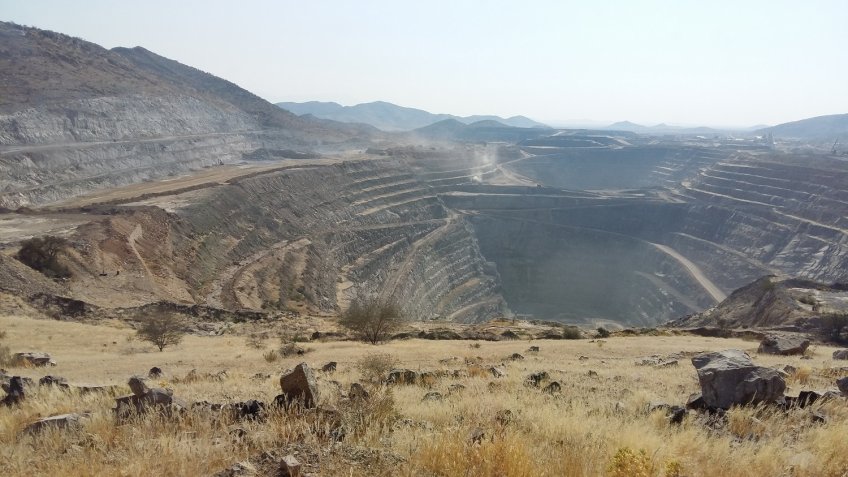
"Mining University, together with Zimbabwe, is ready to work towards the establishment of a science center. Its activities will help answer many questions that require an immediate answer. For example, what is the concentration of raw materials at a particular deposit, what methods of their exploitation will be the most effective, and how land reclamation should be carried out thereafter. The scientists of our university are able to carry out such work, they have the appropriate qualifications and high-tech equipment for this purpose," the rector assured.
Zimbabwe's Minister of Higher Education Amon Murwira said the country's President Emmerson Mnangagwa himself is interested in cooperating with Mining University.
"The priority task now is to concentrate on the detailed elaboration of all potential areas of interaction that were announced today and during our previous meetings. We are well aware that our Russian colleagues are capable of making an invaluable contribution to the development of our state and we are ready to launch the process as soon as possible," Amon Murwira emphasized.
The parties agreed to form a team consisting of representatives of Mining University, which will go to Zimbabwe. On the spot, specialists will be able to assess the real scale of work and make a prospective plan of cooperation.
Recall that the Republic is located in the southern part of the African continent and is considered one of its poorest countries. The vast majority of residents are employed in the agricultural sector. According to experts, it is the mining industry that could become a driver of the state's development. Today, gold, iron, coal, silver, nickel and platinum are mined on its territory.
