
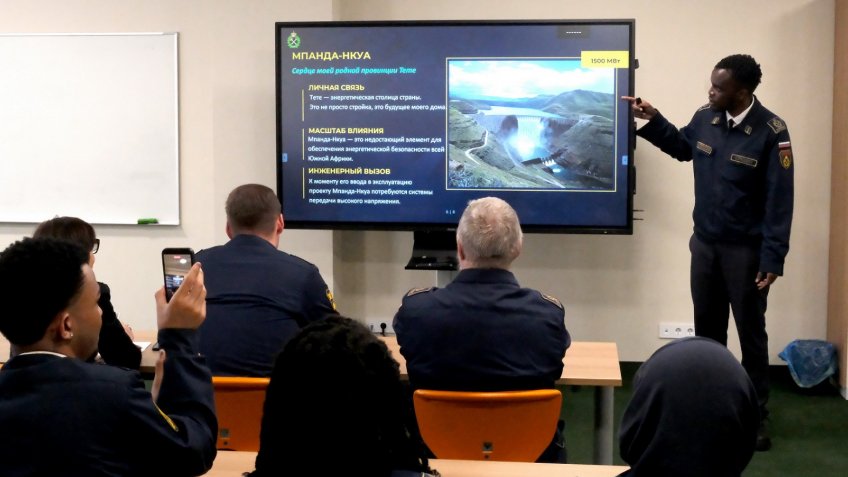
On the eve of Russian Language Day, a presentation session for students of the preparatory department for international students was held at the Center for Language Competencies of Saint Petersburg Mining University. Upon the completion of their one-year course of study, they demonstrated their proficiency in the Russian language within the conditions of a real conference, featuring a panel of judges and spontaneous questions from the audience.
Throughout 2026, representatives from 20 countries studied at the preparatory department: Angola, Brazil, Vietnam, Ghana, Greece, Djibouti, Zimbabwe, Israel, Indonesia, Iraq, China, the Republic of the Congo, Lebanon, Libya, Mauritania, Mozambique, Mongolia, El Salvador, Tanzania, and Ecuador. The "Podfak" (preparatory faculty), as the young people call it themselves, is a structural subdivision of the university that helps them adapt to the Russian educational system, master the Russian language, and prepare for admission into their first year of study. The department's programs traditionally incorporate the study of specialized disciplines aligned with each student's chosen major.
The modern Russian language is objectively challenging to master—its lexical core numbers approximately 500,000 words, combined with a multitude of grammatical and phonetic complexities such as noun cases, the "ы" sound, and the distinction between soft and hard consonants. Nevertheless, the relevance of studying it remains powerful: it is one of the official languages of the United Nations, ranks among the top five leading languages in the world for scientific communication, and is within the top ten largest languages by total number of speakers.

«For international students at the Mining University, the Russian language is not only a means of sociocultural adaptation but also a vital tool for the professional development of a future engineer. The methodological concept of the Center for Language Competencies is based on a sequential transition from linguistic adaptation to academic and professional communication. Even at the preparatory department stage, students master elements of the scientific style of speech, learn to work with specialized educational and scientific texts, prepare presentations, and speak before an audience. This structural approach will allow them to study specialized disciplines, interact with professors and classmates, and present the results of their work», - emphasized Vyacheslav Zyrin, Director of the Center for Language Competencies.
In 2026, the Center held several events aimed at developing cultural and linguistic exchange between international and Russian students. These included a Poetry Evening, active participation of "Podfak" students in university clubs, attendance at open lectures, seminars, and forums, and special thematic events for students from African countries, during which they spoke about their nations, history, geography, educational systems, and cultural heritage.
The "PO Nauke" (On Science) presentation session on Russian Language Day is being held at the Mining University for the second consecutive year. Its objective is to develop professional communication skills in Russian, motivate preparatory department students to engage in public speaking, and encourage the use of Russian to present scientific and professional ideas.
The primary theme of the presentations was "My Profession is Needed by My Country." In the Year of the Unity of the Peoples of Russia, participants were also offered an additional theme—"The History and Culture of My People"; however, the majority of students opted for the first variant. Preparing these presentations allowed the future miners to reflect on the role of their future profession in the development of their respective states.
«At the age of 15, I left my native Tete for Matola to study to be an electrician at one of the best technical institutes in Mozambique. During my studies, I worked at a plant and performed electrical installation work. I saw city hospitals and schools without electricity, not to mention entire villages far from administrative centers. There, electricity is not a comfort; it is life. That is how the dream to study electric power and electrical engineering was born. The Russian language is one of the important steps on the path to its realization. It is one of the most widely spoken languages in the world and is broadly used in science, industry, and international cooperation. Giants such as Gazprom, Rosatom, and other Russian companies operate worldwide. In my country, for example, Rosneft is present. Knowing the language opens doors to internships and broad career opportunities. But for me, Russian is something more. It is the language in which I am learning to think like an engineer, solve problems, and build the future of my country. Where do I plan to work after graduating from the university? Wherever my homeland needs me. If an engineer is needed on large-scale energy projects—I will be an engineer. If a teacher is needed to pass on knowledge to the next generation—I will be a teacher. If we are talking about a dream job—it is hydroelectric power plants. They were what brought me into this profession six years ago and remain my primary goal», - shared Simao Simao Januario.

«My story is the story of a girl from the Mongolian countryside who dreams of becoming a geologist. I was born in the village of Sagil in the western part of the country. The mining industry has always played a highly critical role in our economy, and the development of the state is largely tied to this sector. It accounts for 95% of total exports. I would like to make my own contribution to the future of Mongolia, which is why I decided to become a mining engineer. My interest in mining emerged during my school years when I began studying natural resources, extraction methodologies, and modern technologies that render operations in this field more efficient and secure. The Russian language is very important to me, as it helps me acquire professional knowledge, communicate with professors and students, and familiarize myself with the culture of Russia. When searching for a higher educational institution, I chose Saint Petersburg Mining University—it provides deep theoretical knowledge and practical training. I am confident that after graduation, I will be able to feel secure in my profession and have no doubts about the quality of the education received», - recounted Bataasuren Nandintsetseg.


«In the world of technology and engineering, two languages hold dominant positions today: English and Russian. In the future, I want to become a highly qualified programmer and work within the public sector. Today, Brazil is actively expanding its cooperation with Russia, so knowledge of Russian will unlock supplementary professional opportunities for me. I already speak four languages. This helps broaden my horizons and continuously creates new prospects for my professional development and the well-being of my family», - noted Luis Alcantara.

«I am deeply fond of physics and mathematics, working with figures and formulas. I am particularly interested in the mechanics of machinery operations. In my view, there are many large-scale and critical avenues in this field that will be in demand in the future. I want to become a mechanical engineer and have the opportunity to work both at home—in the technological hubs of Palestine, for instance, in Haifa—as well as in Russia, in Saint Petersburg and Moscow. A degree from the Mining University will allow me to realize my potential in the sectors of renewable energy, power engineering, and infrastructure optimization. Technical training encompasses the study of mechanics, materials science, thermodynamics, machine science, and other disciplines. These competencies will help resolve challenges in design, process optimization, technical maintenance, and the modernization of various systems and equipment. The necessity to study the Russian language does not frighten me; quite the contrary. Around 20% of the population in my country speaks Russian, particularly in regions featuring manufacturing plants, scientific institutes, and laboratories. Therefore, for me, it is the language of technology», - reported Adnan Jamal Musa.
For many students of the preparatory department, this presentation session marked their first serious public speaking experience in the Russian language before an unfamiliar audience.