Science and technics

Записки Горного института
The intensification of technological processes in the oil and gas industry is an urgent task for industrial production. Improving the efficiency of the processes leads to a decrease in the consumption of materials by the apparatus and the cost of their manufacture, an improvement in the quality of the produced product, and simplifies the transportation and installation of equipment. To achieve these goals, a new highly efficient equipment is being developed based on the use of various physical and chemical phenomena, their combinations, and new technological approaches. One of the most effective ways to solve such problems is pulse impact on the materials being processed, in which inhomogeneities of the process driving force are artificially created. The challenge of intensifying the processes occurring during the direct contact of the phases is the need to influence the system being processed locally - in the area of the interface, since it is there that the substances transfer from one phase to another. The object of article’s scientific research – mass-exchange process, which is most widespread in oil and gas technology. As a model, the process of liquid evaporation is chosen, on which the separation of mixtures by rectification is based – the main process of the oil and gas processing industry. The heterogeneity of the driving force of the mass transfer process was created using a thermoelectric converter, the principle of which is based on the Peltier effect, in a series of experiments. Such converters allow creation of higher temperature gradient and, consequently, a greater temperature heterogeneity in the investigated system compared with traditional resistance electric heaters at the same energy expenditure. The article discusses the influence of the temperature inhomogenities location on the efficiency of mass-exchange processes, specifically the evaporation process. In experimental studies, the evaporation rate was estimated by measuring the mass evaporation velocity of a liquid. It is noted that the creation of a temperature gradient on the free surface of the liquid phase using a Peltier element with a specific power of 1.8 kW/m2 leads to a twofold intensification of the evaporation process. Объект научных изысканий статьи – массообменый процесс, имеющий самое широкое распространение в нефтегазовой технологии. В качестве модельного процесса выбран процесс испарения жидкости, на котором основано разделение смесей путем ректификации – главном процессе нефтегазоперерабатывающей промышленности. Неоднородность движущей силы массообменного процесса в серии проводимых экспериментов создавалась с помощью термоэлектрического преобразователя, принцип которого основан на эффекте Пельтье. Такие преобразователи позволяют создать больший градиент температур и, соответственно, большую температурную неоднородность в исследуемой системе по сравнению с традиционными электронагревателями сопротивления при тех же затратах энергии. В статье рассмотрено влияние расположения температурных неоднородностей на эффективность массообменных процессов, а именно процесса испарения. При экспериментальных исследованиях интенсивность испарения оценивалась путем измерения массовой скорости испарения жидкости. Отмечено, что создание градиента температур на свободной поверхности жидкой фазы с помощью элемента Пельтье с удельной мощностью 1,8 кВт/м2 приводит к двукратной интенсификации процесса испарения.
турмалин
The research focused on the composition of tourmaline from tin ore deposits and ore occurrences within the Verkhneurmiysky ore cluster in the Amur region. The aim of the study is to determine the indicative signs of tourmaline from cassiterite-quartz and cassiterite-silicate formations. This research is based on the materials of a long-term study of the mineralogy of the Far East deposits, conducted at the Mining University under the scientific supervision of Professor Yu.B.Marin. The relevance of the study involves predicting of tin and associated mineralization. For the first time, SIMS and Mössbauer spectroscopy were used to study tourmaline from this region. We identified the typomorphic characteristics of the tourmaline composition, which are proposed to be used as indicators of tin-ore deposits. Typomorphic characteristics of tourmaline from cassiterite-quartz formation: schorl (Mg/(Mg + Fe) = 0.06) with a high content of Al and K; Fe3+/(Fe3+ + Fe2+) = 0.03; ZFe3+ = 1 %; impurities: Nb, LREE (La, Ce, Pr), Be, Bi, F, Li, and Mn; LREE content > 9 ppm; positive Gd anomaly. Typomorphic characteristics of tourmaline from cassiterite-silicate formation: schorl-dravite (Mg/(Mg + Fe) = 0.22) with a high Ca content; Fe3+ / (Fe3+ + Fe2+) = 0.17; ZFe3+ = 9 %; impurities: Zr, Y, Cr, V, Sn, In, Pb, W, Mo, Ti, HREE, Eu, Sr, Sb, and Sc; the content of Y is > 2 ppm, of HREE is > 3 ppm, Eu is > 0.1 ppm. The formation conditions of the cassiterite-silicate ore mineralization were more oxidizing than those of the cassiterite-quartz one. Tourmaline, formed under oxidizing conditions, contains such impurities as Sn, In, Nb, Bi, Sc, and LREE. The content of Sn isomorphic impurity in tourmaline reaches 8000 ppm.

Записки Горного института
Data are presented on the geology of areas of rare metal granites proliferation in the Russian sector of the Pacific Ore Belt that make one take a fresh look at the East Asian granitoid area to update its metallogeny. History is reviewed of studying rare metal granites of the Russian Far East. As a rule, these are found in the vicinity of major tungsten-stanniferous ore deposits, except much later than discovering the former, at the stages of their assessment and survey. Rare earth granites are usually missed by the geologists during the early stages of regional geological surveys due to their small size, weak eroding and external similarity with earlier granites. Using the examples of the Central Polousny, Badzhal and Kuyviveem-Pyrekakay regions the structural and geological conditions are characterized of localization of rare metal granites. Comparative analysis of geological situations made it possible to formulate the areal character of manifestation of rare metal granites; their confinedness to late Mesozoic orogenic arched uplifts of bogen structures above deep granitoid batholiths; positioning in the areas where longitudinal and transversal deep laying faults cross; gravitation to the environs of pre-Cambrian median masses. Similarity of structural-geological conditions for manifestation of the well-studied ore-containing granites serves to confirm the hypothesis on the joint stage of late Cretaceous rare metal magmatism in the Russian sector of the Pacific Ore Belt and the existence in the region of a magmatic super-province – the Far East belt of rare metal granites that includes the Novosibirsk-Chukotka, the Yana-Kolyma and the Sikhote-Alin rare metal – granite provinces.
PJSC LUKOIL has become the Gold Sponsor of the 6th Future Leaders Forum of the World Petroleum Council. The agreement establishing the terms of cooperation has been signed between the Company and the Russian National Committee of the World Petroleum Council.
Сокровища Горного музея. Кальцит
Calcite is chemically speaking calcium carbonate. The mineral literally forms the skeleton of our planet. Mountain systems, the Great Barrier Reef in Australia, as well as such life forms as starfish, hedgehogs, snails or mollusks – they all are composed of calcite.
записки горного
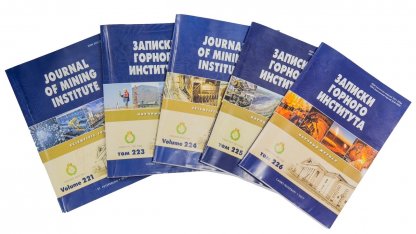
The journal of the Mining University, which is celebrating this year its 112th anniversary, has been accepted for inclusion in the Scopus database.
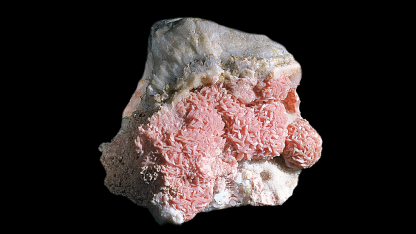
Сокровища Горного музея. Родохрозит
Rhodochrosite is a mineral that resembles a blossom of a rose due to its colour and texture coating. The multilayered mineral is undoubtedly as beautiful as malachite or charoite.
патент
The oldest technical university in Russia was granted with a few patents for inventions aimed at increasing competitiveness of domestic engineering. One of the inventions is a method of magnetic-abrasive polishing.
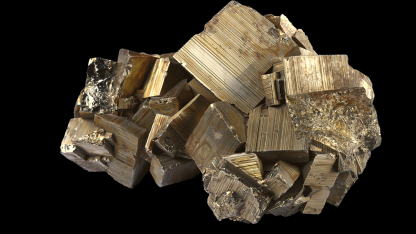
Пирит
Pyrite got its name due to its specific properties, such as being able to sparkle upon impact. In Greek the mineral’s name means ”a stone that strikes fire”. In fact, 200 years ago there was almost no other way to light the fire but to use pyrite or flint as the ”matches”. The stone is often mistaken for gold because of its color and glitter. Spanish conquistadors and gold diggers, who often lacked literacy, either mined or took away cube pyrites from the locals, believing that those were the precious stones. Thus, pyrite got another name - ”fool’s gold”.
Горный университет
Young researchers from the Mining University are the new holders of a prestigious Russian Federation Government Award in Engineering Science