
President of Russia Vladimir Putin has signed a law ratifying the agreement between the Government of the Russian Federation, the United Nations Educational, Scientific and Cultural Organization (UNESCO), and the International Competence Centre for Mining-Engineering Education on the renewal of its status under the auspices of UNESCO until 2033.
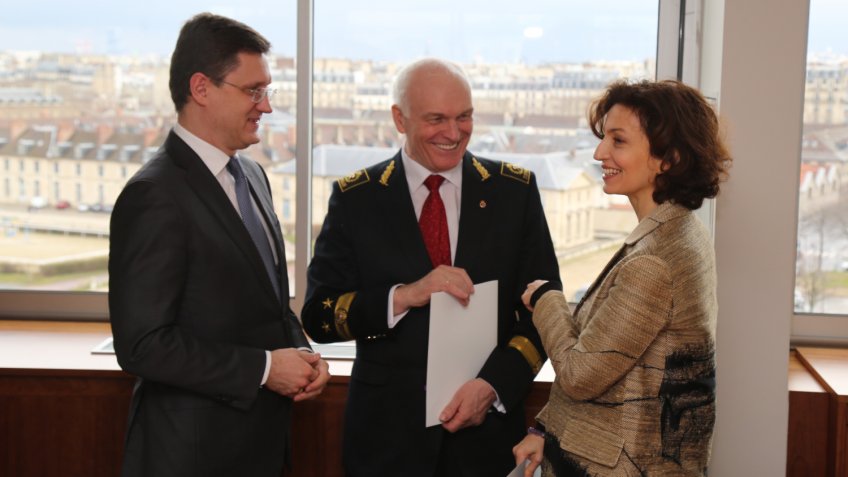
The Centre has been operating on the basis of Empress Catherine II Saint Petersburg Mining University since 2019, when the first agreement with UNESCO—signed in Paris in March 2018—entered into force. This is the second renewal of the Centre’s status. It is one of four UNESCO centres related to engineering sciences that operate as legally independent institutions and have been designated by the international organization as global hubs for the concentration of knowledge and expertise in specific educational specializations.
The Centre’s activities are carried out in five key areas: the creation of a unified space in mining engineering education; the professional certification of specialists and educators; the organization of international events within its field; support for scientific research; and the establishment of flagship educational and research centers based at leading universities, mineral resource and energy companies worldwide.
The Centre’s work is highly regarded, in particular by the Committee of the State Duma of the Russian Federation on International Affairs:
«The Centre makes a significant contribution to mining engineering education worldwide, especially in Asia, Africa, and Latin America, successfully implementing projects in various fields of science and innovation, developing sectoral competencies and youth programs, and cooperating with a large number of international partners, including educational institutions».
UNESCO patronage, together with Empress Catherine II Saint Petersburg Mining University’s strong and stable position among the world’s top five universities in the field of mining engineering (according to the QS subject rankings), enables the Centre to build effective cooperation with international partners.
With the Centre’s support, the university consortium Nedra Africa was established in 2023, bringing together more than 130 universities, research institutes, geological communities, and mining and metallurgical companies from 42 African countries. One of its most successful initiatives has been the one-year, full-time professional retraining program “Management of Subsoil Use Facilities” for employees of mineral resource companies and government bodies of African countries.

In October 2025, Saint Petersburg hosted the Russian–African Raw Materials Dialogue “Development Path: Raw Materials and Personnel as the Basis of Economic Sovereignty.” The core focus of the discussions was the importance of African countries achieving genuine sovereignty through the effective utilization of their natural resource potential. Following the forum, a declaration containing a concrete roadmap was adopted. These recommendations received high praise from experts and were incorporated into the final document of the Second Ministerial Conference of the Russia–Africa Partnership Forum, confirming the Dialogue’s high status as an important instrument of intergovernmental cooperation.
A demonstrative example of effective international scientific cooperation is provided by joint Russian–Iranian programs. These include collaborative scientific research, as well as faculty and student exchanges. On the Iranian side, the most active participants in this cooperation are Shiraz University, the Institute for Science and Technology Monitoring and Citation of the Islamic World (ISC), the Research Institute of the Petroleum Industry, and Shahid Beheshti University.

Cooperation with Malaysia is developing dynamically. An agreement has been reached to hold a forum this year with the participation of representatives from the academic community, business, and government authorities in the field of subsoil use, in the format of a raw materials dialogue. The forum's agenda will be formed based on the results of regular seminars between scientists from Russia and Malaysia, during which areas of mutual research interest are identified.

In China, the most active partners in joint projects with Empress Catherine II Saint Petersburg Mining University are Taiyuan University of Technology (TYUT) and the China University of Mining and Technology (CUMT). This cooperation includes student and postgraduate exchanges, as well as joint research activities.

The UNESCO Centre maintains constant focus on promoting the new model of engineering education that Empress Catherine II Saint Petersburg Mining University is developing and implementing within the framework of the presidential pilot project. The Ministry of Science and Higher Education of the Russian Federation highly appreciates the efforts of the Mining University as the leader of this pilot project. The University’s educational model is being prepared for large-scale implementation across the Russian Federation, and, owing to the efforts of the UNESCO Centre, it is also gaining support abroad.