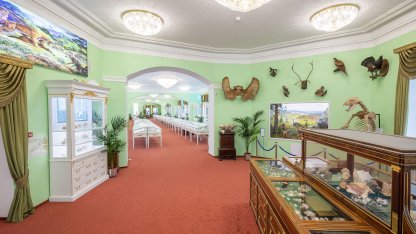
The regional and monographic collections of fossil flora and fauna are arranged in chronological sequence according to the geological period. The specimens showcase the geological record of our planet from the Neogene to the most ancient Archean deposits.
The exposition dedicated to the Quaternary - the shortest geological period in the history of Earth, in which modern humans evolved - opens up the Mining Museum’s geological collection.
The collection of models can be traced back to 1773 when the Mining School was opened, with the primary purpose being to help Russian students in handling mining and engineering equipment.
The Hall exhibits items of decorative and applied art and jewelry made of malachite, lapis lazuli, rhodonite, charoite, labradorite, gypsum, marble, agates, rock crystal, amethyst, as well as jade, agalmatolite, jet and other ornamental stones.
The Hall exposition illustrates the links between mineral formation and various geological processes - from magmatic to supergene - through collections gathered from multiple deposits.
Continuing with the systematic collection of minerals, this Hall is home to a vast class of silicates. Samples of garnets and zircons are represented mostly by ores from the famous mines of the Urals.
The Hall’s exposition was conceived and is still in use in the learning process as an introduction to mineralogy demonstrating the basic concepts of science.
The Mining Museum houses a rare collection of minerals, ores, rocks, paleontological rarities, models and maquettes on the history of mining and engineering equipment, cold steel, stone-cutting and jewellery art. There are over 240 thousand exhibits, many of which are unique.
The first exploration well for oil is traditionally attributed to the Americans. They have devoted more than one film to the search for ”black gold”, cementing this stereotype. However, 20 years before the famous Pennsylvania discovery of Edwin Drake, a Russian geologist began to develop a project to extract raw materials by drilling.
The name of this inventor and engineer is associated with the appearance of the first Russian car, firefighting vehicle, trolleybus and omnibus. But what is especially surprising is that then, back in 1900, he demonstrated a super-fashionable vehicle even by today’s standards.
All of St. Petersburg knew the story of the escape from prison of the anarchist theorist Pyotr Kropotkin. People were telling it again and again as an action-packed novel, adding to the story and thinking out the details. One of the participants of the adventure was young Evgraf Fedorov, the man, whose scientific accomplishments in the field of crystallography today are compared with the periodic system of Mendeleyev.
 Форпост Северо-Запад